



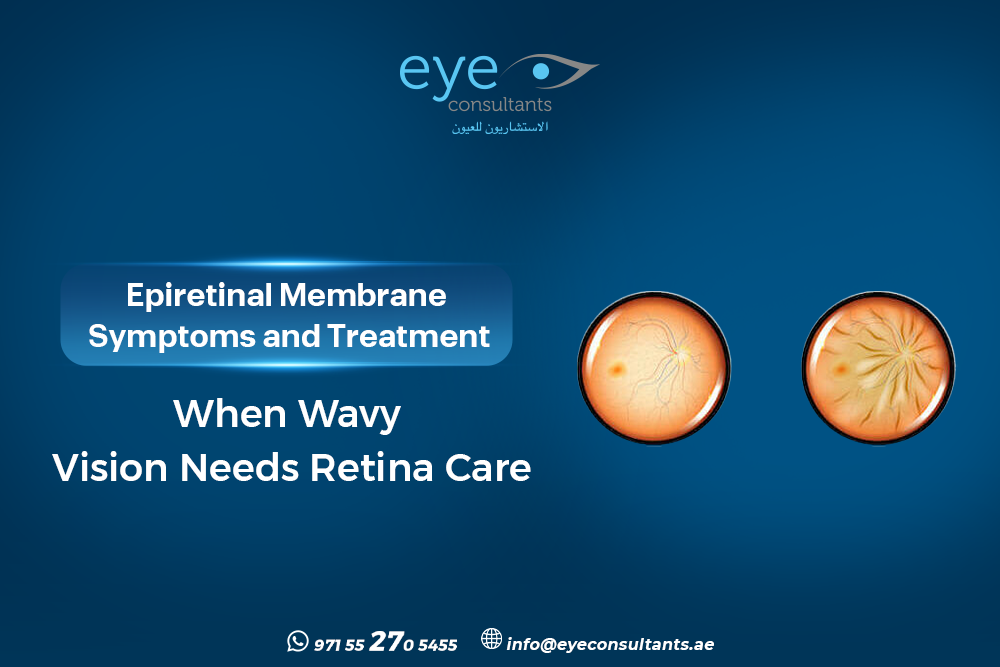
Epiretinal membrane symptoms and treatment often become important the moment straight lines start to look bent, print feels harder to read, or one eye seems less sharp than the other. Many people dismiss these changes as normal aging or glasses trouble. But an epiretinal membrane, also called a macular pucker, can affect the macula and distort central vision over time. That is why early retina assessment matters when visual distortion starts to interfere with daily life.
✆ WhatsappEpiretinal Membrane Symptoms and Treatment: What Should You Watch For?
This condition often develops gradually, so the warning signs may feel subtle at first. Common features include:
- Wavy or distorted central vision
- Blurred central vision
- Difficulty reading small print
- Trouble seeing fine detail clearly
- Different image size or shape between the two eyes in some cases
An epiretinal membrane is a thin layer of scar-like tissue that forms over the macula. As it contracts, it can wrinkle the retinal surface and make objects appear crooked or blurred. In mild cases, monitoring may be enough. In more bothersome cases, treatment may need to move beyond observation.(Watch this video)
When Is Treatment Needed?
Understanding epiretinal membrane symptoms and treatment begins with evaluating how much the membrane is affecting vision and daily activities. Specialists usually assess several factors before recommending the next step.
They may consider:
- How distorted the vision has become
- Whether reading, driving, or screen use is affected
- Whether symptoms are stable or gradually worsening
- OCT findings and the degree of macular traction
Treatment for epiretinal membrane depends on the severity of visual distortion. In mild cases, doctors may recommend regular monitoring. When vision becomes significantly affected, a surgical procedure called vitrectomy with membrane peeling may be considered to improve visual clarity and reduce distortion.
How Is Epiretinal Membrane Diagnosed?
A thorough retina evaluation is essential when assessing epiretinal membrane symptoms and treatment. The goal is to confirm the diagnosis and determine how much the macula is affected.
This evaluation may include:
- Detailed retinal examination
- OCT imaging of the macula
- Vision and distortion testing
- Assessment of other retinal causes of blurred or distorted vision
OCT plays a critical role because it provides high-resolution images of the retinal layers and clearly shows how the membrane affects the macula.
What Does Treatment Usually Involve?
The approach to epiretinal membrane symptoms and treatment depends primarily on symptom severity rather than imaging alone.
Possible management options include:
- Observation when symptoms are mild and stable
- Updated glasses prescriptions in selected mild cases
- Vitrectomy with membrane peeling when distortion significantly affects vision
For patients whose central vision becomes clearly distorted, surgery may be recommended. The procedure typically involves a vitrectomy performed by a retina specialist to remove the membrane from the macula.
The goal of epiretinal membrane symptoms and treatment in these cases is to reduce visual distortion and help stabilize or improve functional vision, although recovery timelines and final outcomes can vary between patients.
Why choose Eye Consultants Center for retinal care
Choosing a specialized ophthalmology center is essential when managing retinal disorders.
Eye Consultants Center in Dubai has built a strong reputation over 14 years of service in advanced ophthalmology care. The medical team includes retina specialists with more than 30 years of combined experience in diagnosing and treating complex retinal conditions.
Key strengths include:
- A dedicated department for Vitreoretinal Disease management
- Advanced diagnostic technology including OCT, OCT-A, fundus photography, and retinal imaging
- Modern surgical facilities for minimally invasive vitrectomy procedures
- Comprehensive care covering retinal diseases such as diabetic retinopathy, macular degeneration, retinal tears, and detachment
- Experienced consultants and a multidisciplinary ophthalmology team
The center combines modern technology, specialized expertise, and patient-focused care to provide accurate diagnosis and effective management of retinal conditions, including advanced solutions for epiretinal membrane symptoms and treatment.
Schedule a consultation with the retina specialists at Eye Consultants Center and receive expert guidance for accurate diagnosis and personalized retinal care.
call us:
or visit Al Razi Building 64, Block C, 1st Floor, Unit 1017 – Dubai Healthcare City – Dubai – United Arab Emirates.
Frequently Asked Questions
What causes an epiretinal membrane?
An epiretinal membrane forms when a thin layer of scar-like tissue develops over the retina’s central area, often related to aging changes in the vitreous.
Does epiretinal membrane always require surgery?
Not always. Many cases remain stable and are monitored regularly unless vision distortion significantly affects daily activities.
How is epiretinal membrane diagnosed?
Specialists usually perform a dilated retinal examination and OCT imaging to evaluate the membrane and its effect on the macula.
Can vision return after treatment?
Treatment aims to improve visual distortion and stabilize vision, but outcomes depend on the severity and duration of the condition.
If you notice distorted vision or difficulty reading, early retinal evaluation can protect your eyesight. Understanding epiretinal membrane symptoms and treatment helps patients take timely action and access specialized care.
✆ Whatsapp