


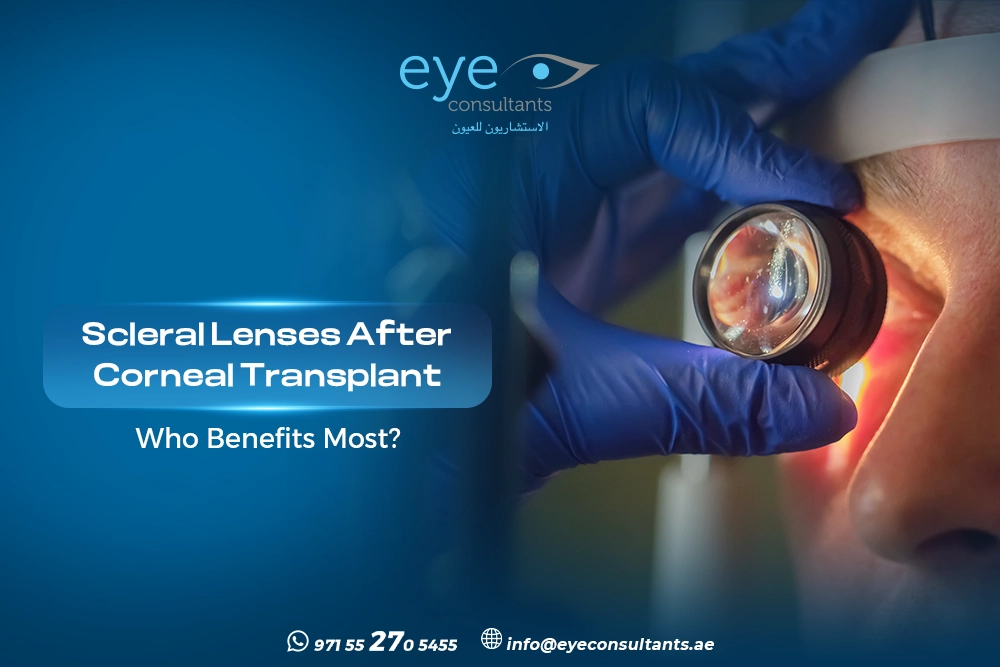
Scleral lenses after corneal transplant often become an important option when a patient expects clearer vision after surgery but still struggles with blur, glare, or unstable sight. Many people are surprised to learn that a successful graft does not always mean regular glasses will provide the best visual result. After corneal transplant surgery, the shape of the cornea can remain irregular, and that can affect how light focuses. That is where the next step in visual rehabilitation often starts to make more sense.
Scleral Lenses After Corneal Transplant – Why Are They Often Recommended?
This option is often considered when the corneal surface remains too irregular for glasses alone to provide stable vision.
- Scleral lenses after corneal transplant can help patients with irregular astigmatism, post-graft corneal shape changes, or fluctuating vision that is not well corrected by spectacles.
- Unlike smaller corneal lenses, scleral lenses vault over the cornea and rest on the sclera, creating a fluid reservoir that can improve optical quality and comfort in complex post-surgical eyes.
- Reviews of post-keratoplasty fitting report that scleral lenses are among the most frequently used specialty lenses after corneal transplantation because they can provide stable vision in difficult corneal shapes.
Who Benefits Most From This Type of Lens?
Not every graft patient needs the same visual solution, so proper selection matters.
Patients who may benefit most from scleral lenses after corneal transplant include:
- Those with irregular astigmatism after penetrating keratoplasty or other graft procedures.
- Those who have good graft clarity but reduced visual quality because the corneal surface is still irregular.
- Those who struggle with lens stability or comfort in smaller rigid lenses.
- Those who need both visual rehabilitation and additional surface protection in selected cases. (Watch this video)
What Should Be Evaluated Before Fitting?
A successful plan depends on more than choosing a lens.
Before prescribing scleral lenses after corneal transplant, doctors usually assess:
- Graft clarity and corneal health.
- Corneal shape, irregularity, and the stability of the graft-host junction.
- Ocular surface condition, tear film, and lens handling ability.
- Any signs that could make fitting less suitable, including significant graft vascularization or other risk factors that may increase concern about rejection.
Why Choose Eye Consultants Center for This Evaluation?
Choosing the right center matters when scleral lenses after a corneal transplant require precision fitting and corneal expertise.
- Eye Consultants Center offers Contact Lenses and Low Vision services, describing “comfortable, customized contact lens solutions” for a wide range of refractive and corneal conditions.
- The center’s services include corneal treatment, investigations, and subspecialty ophthalmology support in Dubai.
- Eye Consultants presents itself as a center built on advanced technology, compassionate care, and broad ophthalmic subspecialties.
- The clinic’s published corneal transplant content states 14 years of center excellence and doctors with over 30 years of expertise, which aligns with the high-level corneal and visual rehabilitation care such cases need. (Watch this video)
If you are still experiencing blurred or unstable vision after a graft, a dedicated assessment for scleral lenses after corneal transplant may offer clearer answers than glasses alone. Book your consultation at Eye Consultants Center.
Call us:
or visit Al Razi Building 64, Block C, 1st Floor, Unit 1017 – Dubai Healthcare City – Dubai – United Arab Emirates.
Frequently Asked Questions
Can scleral lenses be used after a corneal transplant?
Yes. In selected patients, scleral lenses after corneal transplant are commonly used for visual rehabilitation when the corneal surface remains irregular.
Do scleral lenses replace the need for follow-up after transplant?
No. Patients still need regular corneal follow-up to monitor graft health, fit quality, and ocular surface status.
Are scleral lenses always the first choice after a graft?
Not always. The best option depends on graft condition, corneal shape, comfort, and visual goals.
Conclusion
For many patients with irregular post-graft vision, scleral lenses after corneal transplant can play a major role in achieving clearer, more stable sight. When fitting is guided by careful corneal assessment and the right specialty team, the visual outcome can become much more functional and much more reassuring.