


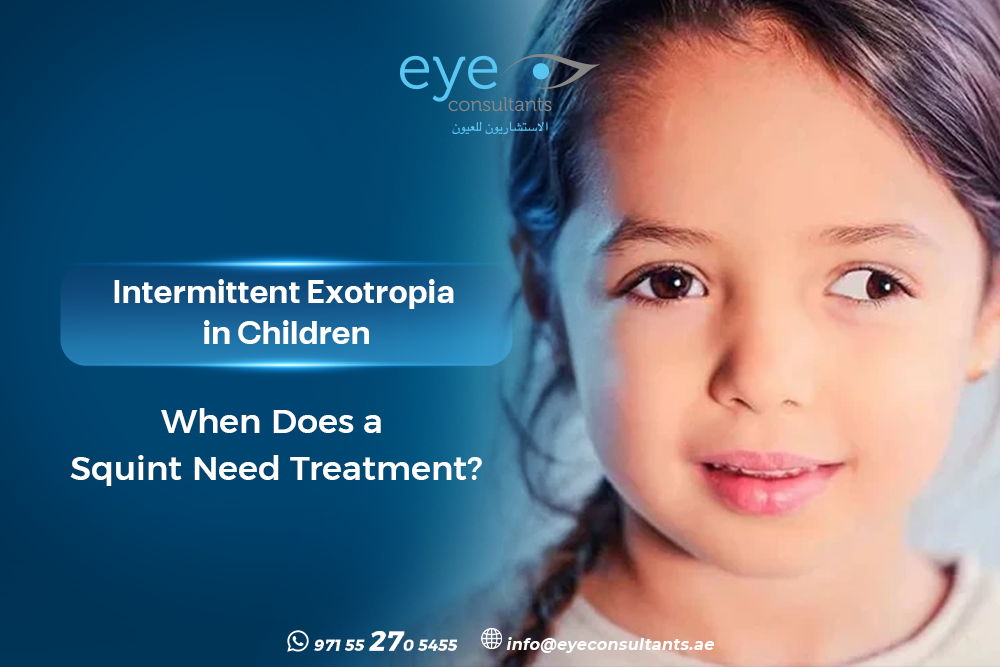
Intermittent exotropia in children often begins with a small sign that parents notice unexpectedly, an eye drifting outward when a child is tired, looking at distant objects, or playing in bright sunlight. Because the deviation appears only occasionally, many families assume it will disappear on its own. However, even intermittent eye misalignment can affect visual development if it becomes more frequent. Understanding when this squint requires medical attention helps parents take the right step at the right time.
Intermittent Exotropia in Children: Understanding the Condition
Intermittent exotropia in children is a common type of squint (strabismus) in which one eye occasionally turns outward instead of focusing in the same direction as the other eye.
This outward deviation may appear only at certain times, including:
- When the child is tired or distracted
- During illness or lack of sleep
- In bright sunlight
- When focusing on distant objects
Because intermittent exotropia in children is not constant, many children can temporarily regain control of their eye alignment. However, if the frequency increases or the control becomes weaker, a specialist assessment becomes important. (Watch this video)
Parents may notice signs such as:
- One eye drifts outward occasionally
- A child closing one eye in bright sunlight
- Tilting or turning the head while focusing
- Difficulty maintaining eye alignment during concentration
These signs help pediatric ophthalmologists determine how well the eyes are working together.
What Happens During a Pediatric Eye Evaluation?
A detailed examination helps determine whether intermittent exotropia in children requires monitoring or treatment.
During a pediatric ophthalmology consultation, doctors typically assess:
- Eye alignment and muscle balance at both near and distance vision
- Control of the deviation, which shows how often the eye drifts outward
- Refractive error testing to check whether glasses may improve control
- Binocular vision and depth perception, which reveal how the eyes cooperate
- General eye health, to rule out structural causes
Because young children may struggle to describe visual symptoms, these specialized tests help provide a clear diagnosis.
When Does Intermittent Exotropia in Children Need Treatment?
Not every case requires immediate intervention. The decision to treat depends on how the condition affects visual function and daily life.
Doctors may recommend treatment if:
- The outward deviation becomes more frequent
- The child struggles to regain eye alignment
- Binocular vision or depth perception begins to decline
- The squint becomes noticeable in daily activities
- Visual discomfort or double vision appears in older children
Management approaches vary depending on the individual case and may include:
- Glasses to correct refractive errors
- Amblyopia therapy when needed
- Orthoptic monitoring and exercises in selected cases
- Surgical correction when eye muscle alignment requires adjustment
A careful evaluation ensures that treatment decisions support long-term visual development.
Why Choose Eye Consultants Center for Your Child’s Eye Care?
Choosing a specialized center is essential when evaluating intermittent exotropia in children.
Eye Consultants Center in Dubai Healthcare City provides advanced pediatric ophthalmology services designed specifically for children and their visual development.
Key advantages include:
- 14 years of clinical expertise in ophthalmology services in Dubai
- Doctors with more than 30 years of combined experience in eye care and surgical treatments
- Dedicated Squint and Pediatric Consultation services
- Advanced diagnostic technology designed for accurate pediatric eye assessment
- A team of highly trained specialists and supportive staff focused on patient comfort
- Modern facilities and internationally recognized clinical standards
If you notice signs of eye drifting, closing one eye in sunlight, or unusual head posture while focusing, a pediatric eye evaluation can provide clarity and reassurance.
Book a consultation with the Consultants at Eye Consultants Center to assess your child’s eye alignment and visual development. (Watch this video)
Call
or visit Al Razi Building 64, Block C, 1st Floor, Unit 1017 – Dubai Healthcare City – Dubai – United Arab Emirates.
Early consultation helps guide the right care plan and supports healthy vision during childhood development.
Frequently Asked Questions
Is intermittent exotropia in children common?
Yes. It is one of the more common types of childhood squint, where one eye occasionally drifts outward instead of remaining aligned with the other eye.
Can it improve without treatment?
Some children maintain good control of their eye alignment for a period of time. However, regular follow-up with a pediatric ophthalmologist is important because the condition can gradually become more frequent.
Does every child need surgery?
No. Surgery is usually considered only when the eye deviation becomes frequent, difficult to control, or begins to affect binocular vision or daily activities.
When should parents seek medical advice?
Parents should consult a specialist if eye drifting occurs repeatedly, persists beyond early infancy, or is accompanied by eye closing, head turning, or visual complaints.
In many cases, intermittent exotropia in children can be monitored safely when detected early and evaluated by a pediatric eye specialist. A timely consultation helps determine whether observation, vision therapy, or other treatment is needed to support healthy eye alignment and visual development.