



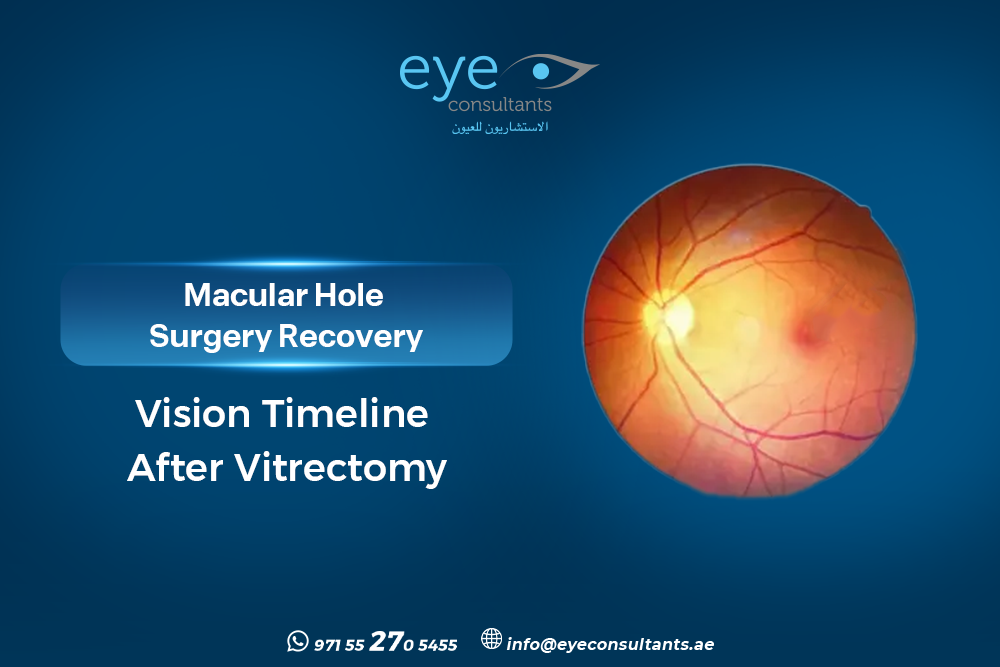
Macular hole surgery recovery often starts with the same worry: When will my vision begin to feel normal again? The first days after vitrectomy can feel unsettling because the gas bubble blurs sight and daily routines suddenly change. What matters most is understanding the expected vision timeline, the limits of recovery, and the warning signs that should never be ignored. That is where clarity replaces anxiety, and the next step becomes easier.
✆ WhatsappMacular hole surgery recovery: what to expect after vitrectomy
Understanding the stages of macular hole surgery recovery helps patients approach the healing period with realistic expectations and less uncertainty. Vision improvement usually follows a gradual pattern after vitrectomy as the retina stabilizes and the macula begins to heal.
- First few days: Vision is usually very blurred because a gas bubble is often placed inside the eye to support healing. Some patients are asked to keep a face-down position for a period decided by the surgeon.
- First 2 to 8 weeks: The gas bubble gradually shrinks. With short-acting gas, this may take around 2 to 3 weeks; with longer-acting gas, it can take about 2 months.
- First 3 to 6 months: Most visual improvement is usually seen during this phase, although the final result can continue to develop for many months.
- Up to 12 months: Some patients continue to notice gradual change for up to a year. Even after successful closure, vision may not return exactly to how it was before the macular hole developed.
What supports smoother macular hole surgery recovery?
A steady macular hole surgery recovery depends on careful follow-up and realistic expectations.
- Follow your surgeon’s positioning advice exactly if a gas bubble was used.
- Avoid flying or high-altitude travel until the gas bubble has fully gone.
- Expect distortion to improve gradually, not overnight. Macular hole surgery recovery is often measured in weeks and months, not days.
- Keep every review visit so healing can be checked with retinal imaging when needed.
When to call your retina specialist
This part highlights symptoms that should not wait during macular hole surgery recovery.
- Increasing pain
- Sudden drop in vision
- New flashes or many floaters
- Worsening redness or discharge
These symptoms do not always mean a serious complication, but they deserve prompt assessment by an ophthalmologist (Watch this video)
Why choose Eye Consultants Center?
When recovery depends on precise diagnosis and skilled follow-up, the treating center matters. Eye Consultants Center highlights a dedicated Vitreoretinal Disease service, retina-focused consultants, OCT and OCT-A imaging, fundus photography, and minimally invasive vitrectomy techniques.
The center’s recent site content also emphasizes 14 years of service in Dubai, doctors with 30+ years of senior expertise, thousands of successful procedures and evaluations across services, patient-first communication, and international accreditation.
Ready for a retina consultation? Call us:
or visit Al Razi Building 64, Block C, 1st Floor, Unit 1017 – Dubai Healthcare City – Dubai – United Arab Emirates.
FAQ
How long does vision stay blurry after vitrectomy?
Blur is common early on, especially with a gas bubble. Many patients notice gradual improvement over weeks to months.
Is face-down positioning always required?
Not always. It depends on the macular hole and your surgeon’s plan.
Can a macular hole fail to close?
Yes. A small percentage of holes may not close after the first surgery, and further treatment may be considered.
In the end, macular hole surgery recovery is rarely instant, but the right timeline, the right precautions, and the right retina team can make the journey far clearer.
✆ Whatsapp