


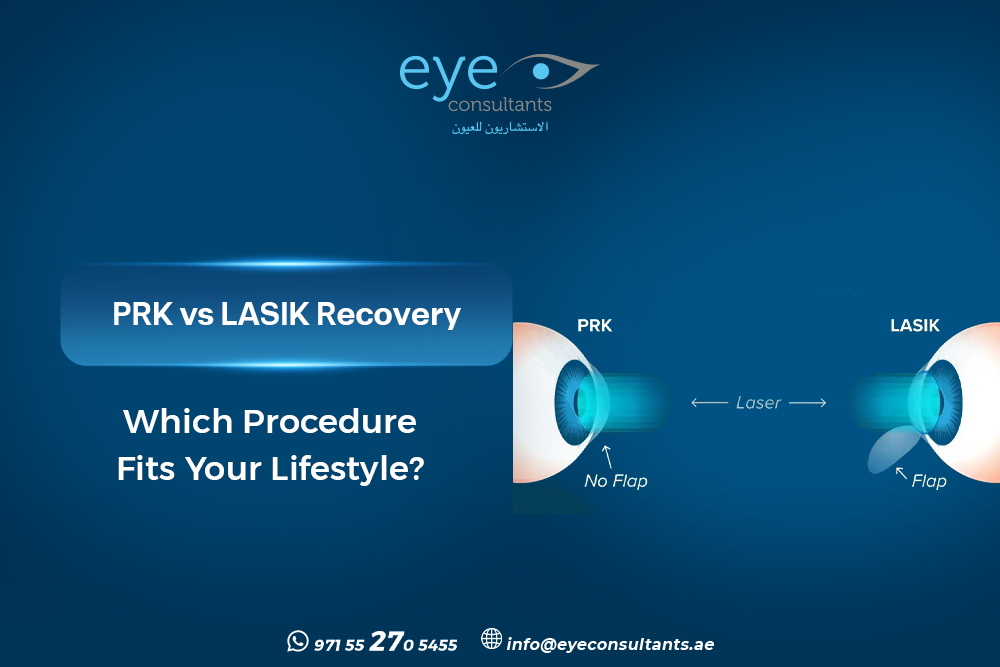
PRK vs LASIK recovery is often the real question behind laser vision correction: not just which procedure works, but which one fits your work schedule, gym routine, screen time, and comfort with downtime. Many patients love the idea of waking up with clearer vision, but then pause when they hear that one option heals faster while the other may suit certain corneas better. That difference matters more than most people expect. The right choice is usually less about trends and more about how your eyes and your daily life match the procedure.
PRK vs LASIK Recovery: What Is the Main Difference?
The biggest difference is recovery speed, especially in the first days after surgery.
- LASIK usually offers faster visual recovery, and many patients can function well the next day.
- PRK has a slower early recovery because the corneal surface needs time to heal.
- PRK vs LASIK recovery is not about one being “better” for everyone; it is about which trade-off fits the patient best.
- Both procedures are established refractive surgeries used to reshape the cornea and improve vision.
In practical terms, PRK vs LASIK recovery often comes down to whether you want quicker short-term convenience or whether your corneal profile and lifestyle make PRK the safer long-term fit. Cleveland Clinic notes that LASIK commonly delivers quicker comfort and clearer vision early on, while PRK may take days to weeks for vision to stabilize more fully.
Which Recovery Timeline Fits Your Lifestyle Better?
This comparison becomes clearer when you match recovery with real-life routines.
LASIK may suit patients who:
- Want a faster return to work
- Prefer quicker visual recovery
- Do not have corneal factors that make a flap less suitable
PRK may suit patients who:
- Have thinner corneas
- Play contact sports
- Want a flap-free surface treatment
- Accept a slower early healing phase for a procedure that may better match their eye profile
When patients compare PRK vs LASIK recovery, they are often comparing convenience versus candidacy. LASIK recovery is typically easier upfront, while PRK can be a strong option when flap creation is less ideal. (Watch this video)
What Should You Expect in the First Week?
The first week often shapes patient expectations more than the procedure itself.
- After LASIK, many patients notice useful vision quickly.
- After PRK, early discomfort, light sensitivity, tearing, and blurred vision are more common in the first few days.
- PRK vs LASIK recovery is therefore an important discussion before booking surgery, not after.
- Final suitability depends on pre-operative testing, corneal mapping, and surgeon assessment.
Why Choose Eye Consultants Center for Lasik & Refractive Surgery in Dubai?
Choosing the right center matters when PRK vs LASIK recovery is only one part of a bigger decision.
Eye Consultants Center highlights:
- Lasik & Refractive Surgery services, including Femto LASIK, Contoura Vision, SMILE, and PRK
- Advanced diagnostic technology and a specialist ophthalmology team across cornea, refractive surgery, retina, glaucoma, cataract, and pediatric care.
- Official site content describing 14 years of proven excellence and doctors with over 30 years of combined expertise in refractive care.
- Official references to awards, recognition, and real success stories, alongside Dubai Healthcare City location details. (Watch this story)
To explore your options with a specialist team, book your consultation at Eye Consultants Center.
Call us:
or visit Al Razi Building 64, Block C, 1st Floor, Unit 1017 – Dubai Healthcare City – Dubai – United Arab Emirates.
FAQ’S
How do I know which option fits me?
A full refractive assessment, including corneal testing, is needed to decide whether PRK vs LASIK recovery aligns with your eyes and lifestyle.
Is LASIK recovery faster than PRK recovery?
Yes. In most cases, LASIK offers faster early visual recovery than PRK.
Is PRK less effective than LASIK?
Not necessarily. Both can be effective; the difference is often recovery and candidacy rather than outcome alone.
Can PRK be better for active lifestyles?
It can be, especially for patients involved in contact sports, because PRK does not create a corneal flap.
PRK vs LASIK recovery should be part of every serious refractive surgery consultation, because the best procedure is the one that matches both your cornea and your routine.