


Axial length myopia control often becomes important after a familiar moment: a child’s glasses prescription changes again, and parents start wondering whether vision is simply changing or whether the eye itself is growing too quickly. In childhood myopia, that distinction matters. Clear vision is only part of the story, while eye growth tells us more about future risk. Once axial length is measured properly, the conversation becomes far more precise.
Axial Length Myopia Control: What Does It Mean?
Tracking the eye’s growth helps doctors understand myopia progression beyond the glasses prescription.
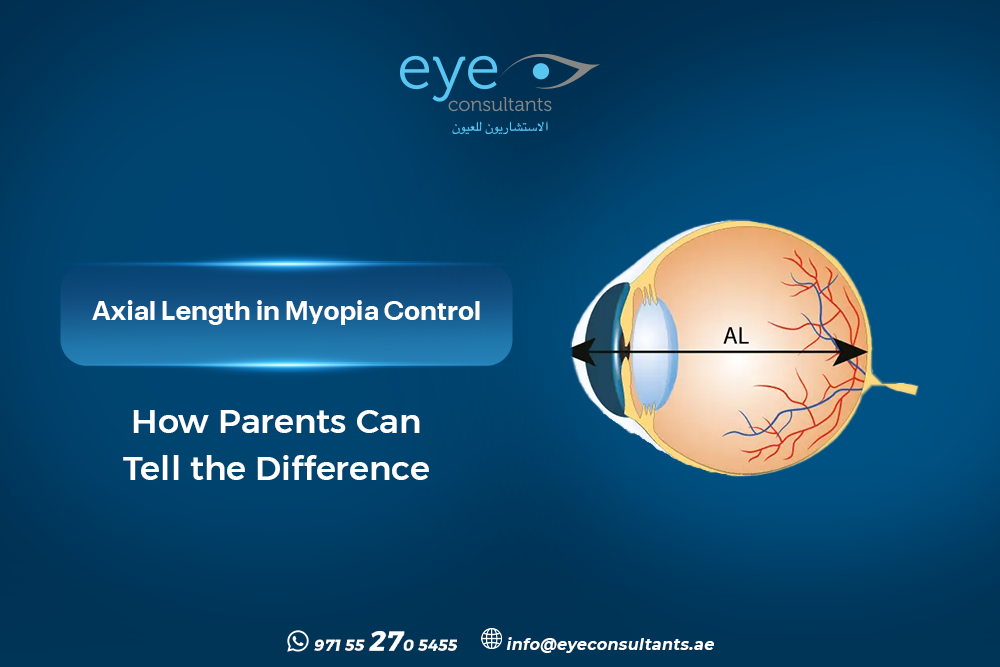
- In myopia, the eye often becomes longer from front to back, which is called increased axial length. That elongation is closely linked to myopia progression in children
- Axial length myopia control helps doctors track whether the eye is elongating faster than expected, even when refraction alone does not tell the full story.
- This is clinically useful because higher myopia and excessive axial elongation are associated with greater long-term retinal and macular risks. (Watch this video)
Why Is Axial Length Measurement So Valuable?
A child may see well with updated glasses and still have ongoing eye growth. (Watch this)
- Refraction can change with accommodation and testing conditions, while axial length is an objective structural measurement.
- International myopia guidance describes treatment efficacy using both refractive progression and slowing of axial elongation.
- For that reason, axial length myopia control supports a more accurate follow-up plan in children who are progressing quickly or have a strong family history of myopia.
What May Be Included in a Diagnostic Myopia Control Plan?
A proper plan combines measurement, risk assessment, and regular review.
- Cycloplegic refraction helps confirm the true degree of myopia.
- Axial length measurement tracks whether the eye is elongating over time.
- Doctors may also review age of onset, parental myopia, screen habits, and outdoor time, as these factors influence progression risk.
- Current evidence-based options for axial length myopia control may include optical, behavioral, and pharmacologic strategies depending on the child’s profile.
Why Choose Eye Consultants Center for This Evaluation?
Choosing the right center matters when axial length myopia control depends on accurate diagnostics and consistent follow-up.
- Eye Consultants Center offers Childhood Myopia Management within its Dubai eye-care services.
- The center specifically highlights diagnostic technology, including axial length measurement and corneal topography for myopia control assessment.
- Across its published pages, Eye Consultants presents 14 years of center expertise and ophthalmologists with more than 30 years of experience across subspecialties.
- The clinic also emphasizes advanced technology, patient-centered care, and a broad ophthalmology network in Dubai Healthcare City.
If your child’s prescription keeps changing, a structured axial length myopia control evaluation can offer clearer answers than glasses updates alone. Book a consultation at Eye Consultants Center.
Call us:
or visit Al Razi Building 64, Block C, 1st Floor, Unit 1017 – Dubai Healthcare City – Dubai – United Arab Emirates.
Frequently Asked Questions
Is axial length measurement necessary for every myopic child?
Not always, but it is especially valuable when progression seems fast, risk is high, or a doctor wants a more objective way to monitor eye growth.
Can axial length change even if the number of glasses changes only slightly?
Yes. That is one reason axial length myopia control is helpful in follow-up. Structural eye growth and refractive change do not always appear identical at every visit.
Does myopia control only mean stronger glasses?
No. Myopia control refers to strategies used to slow progression, not simply to sharpen vision with a new prescription.
In children with progressing nearsightedness, axial length myopia control gives doctors and parents a more reliable view of what is happening inside the eye. When eye growth is measured early and followed carefully, the management plan becomes more precise, more individualized, and more protective of long-term eye health.