


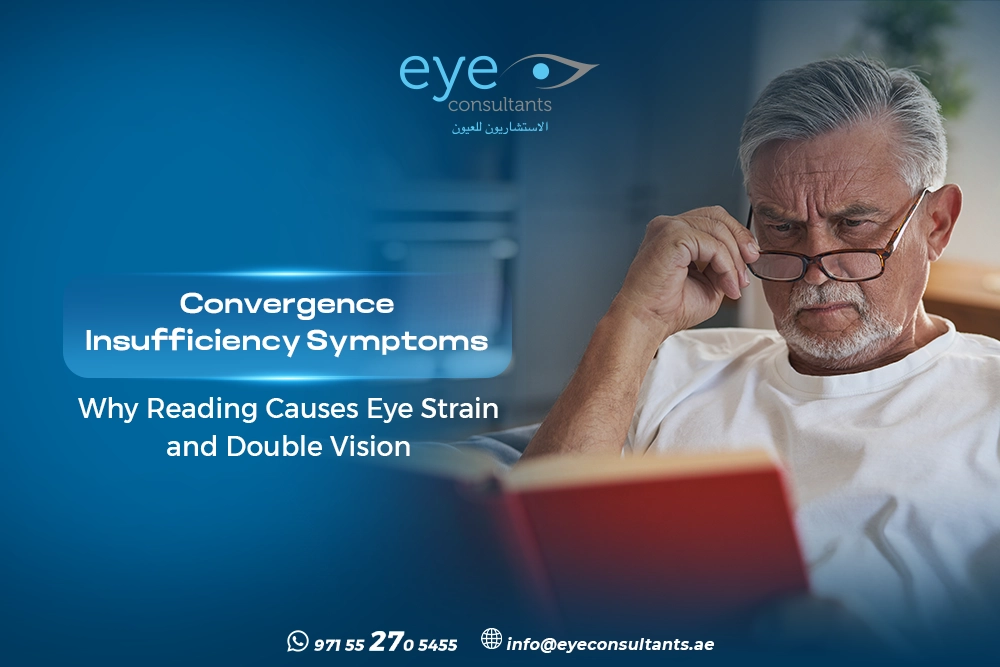
Convergence insufficiency symptoms often appear in situations people assume are normal: a child avoids reading, a student loses focus after a few pages, or an adult feels eye strain and intermittent blur during screen time. The problem may not be the text itself, but how the eyes work together at near. When the eyes struggle to turn inward efficiently for close tasks, symptoms can build quietly and affect comfort, performance, and concentration. That is why a proper binocular vision assessment can matter more than many people realize.
Convergence insufficiency symptoms: what patients should notice
This condition is functionally important because it affects near vision tasks rather than distance clarity alone.
- Convergence insufficiency symptoms often include discomfort during reading or other close work.
- Common complaints include double vision when reading, words moving on the page, loss of concentration, and frequent stopping.
- Some patients also report headaches, tired eyes, or needing to close one eye during near tasks.
- The issue may affect children at school, adults at work, and anyone spending long periods on near visual tasks.
What convergence insufficiency is and how it affects near tasks
This is a binocular vision problem, not simply a need for stronger glasses.
Convergence insufficiency happens when the eyes do not coordinate well enough to turn inward for near work. As a result, reading can become uncomfortable even if distance vision seems fine. This is why convergence insufficiency symptoms may be missed for a long time.
Patients may describe eyestrain while reading, skipping lines, reduced reading stamina, or intermittent blur rather than an obvious eye disease. Vision Therapy services at Eye Consultants Center specifically describe work on eye coordination, tracking, and visual focus, which aligns with the functional nature of this complaint.
Symptoms at school, work, and during screen time
The pattern often becomes clearer when symptoms are linked to real-life tasks.
At school, a child may:
- avoid homework or reading for long periods
- lose place easily on the page
- complain that words blur or double
- seem distracted when the problem is actually visual fatigue
At work or during screen use, an adult may:
- feel eyestrain while reading
- develop intermittent double vision when reading
- need frequent breaks
- struggle more late in the day or after prolonged near focus
These complaints are easy to dismiss, which is why convergence insufficiency symptoms can overlap with concentration issues unless binocular vision is examined directly.
How the diagnosis is made in clinic
A proper diagnosis depends on targeted binocular vision testing.
Clinical assessment may include:
- refraction, to rule out an uncorrected prescription problem
- eye alignment testing
- near point of convergence assessment
- evaluation of fusional reserves and binocular coordination
- review of symptoms during near tasks
Eye Consultants Center highlights advanced diagnostic technology across its pediatric, adult strabismus, and vision therapy services, and its pediatric ophthalmology team is led by a dedicated Head of Pediatric Ophthalmology and Strabismus Unit.
This makes structured assessment especially relevant when convergence insufficiency symptoms affect reading comfort or school performance.
Vision therapy, exercises, prism, and when each is useful
Management depends on the cause, severity, and examination findings.
Possible options include:
- convergence insufficiency treatment through vision therapy when binocular coordination needs active training
- office-based or supervised exercises in appropriate cases
- prism in selected patients when symptom relief is the main goal
- correction of refractive error when needed alongside binocular treatment
Eye Consultants Center offers Vision Therapy in Dubai focused on visual focus, eye coordination, and tracking. For some patients, especially symptomatic adults, this can also overlap with interest in vision therapy for adults when near work is the main trigger.
Treatment decisions should follow examination findings, not assumptions based on symptoms alone.
Child vs adult outcomes and when to seek care early
Outcomes are often better when the problem is recognized before symptoms become long-standing.
Children may show the problem through reading avoidance, poor stamina, or school-related visual complaints. Adults may present later with workplace strain, digital fatigue, and intermittent near diplopia.
In both groups, earlier assessment is useful when symptoms recur rather than appear only rarely. If convergence insufficiency symptoms are interfering with reading, screens, or close work, early evaluation helps identify whether the issue is binocular, refractive, or related to another alignment problem. Eye Consultants Center connects these concerns across Vision Therapy, adult strabismus, and Squint & Pediatric Consultation services.
Why choose Eye Consultants Center?
Choosing the right center matters because binocular complaints require more than a routine vision check.
Eye Consultants Center in Dubai Healthcare City offers Vision Therapy services aimed at improving visual focus, eye coordination, and tracking, alongside dedicated Squint & Pediatric Consultation and adult strabismus services.
The center presents advanced diagnostic technology, subspecialty ophthalmology care, and an established multidisciplinary structure in one location.
Its official pages also confirm the center’s Dubai Healthcare City address, main contact number, and specialist-led ophthalmology teams, including pediatric strabismus expertise under Dr. Mahmoud Youssef Khattab. (Watch this video)
These strengths support careful evaluation when convergence insufficiency symptoms affect daily reading or screen performance.
If reading has become tiring, uncomfortable, or visually confusing, book a binocular vision assessment at Eye Consultants Center.
Contact us at:
or visit Al Razi Building 64, Block C, 1st Floor, Unit 1017 – Dubai Healthcare City – Dubai – United Arab Emirates.
FAQ About Convergence insufficiency symptoms
These are some of the most common questions patients ask before booking.
Can convergence insufficiency cause double vision only at near?
Yes. One of the classic complaints is double vision when reading or during prolonged close work, while distance vision may remain comfortable.
Is convergence insufficiency only a problem in children?
No. It can affect both children and adults, although the complaint may show up differently depending on school, work, and screen habits.
Does every patient need vision therapy?
Not always. Convergence insufficiency treatment depends on examination findings and may include therapy, exercises, prism, or refractive correction depending on the case.
When should someone seek care?
Evaluation is worth considering when reading regularly causes eyestrain, blur, skipping lines, headaches, or intermittent double vision.
Convergence insufficiency symptoms are often overlooked because patients can still see clearly at distance and may not realize the problem is binocular. But when near tasks repeatedly trigger strain, blur, or double vision, the issue deserves targeted assessment. With the right diagnosis and management plan, both children and adults can move forward with clearer, more comfortable near vision.