


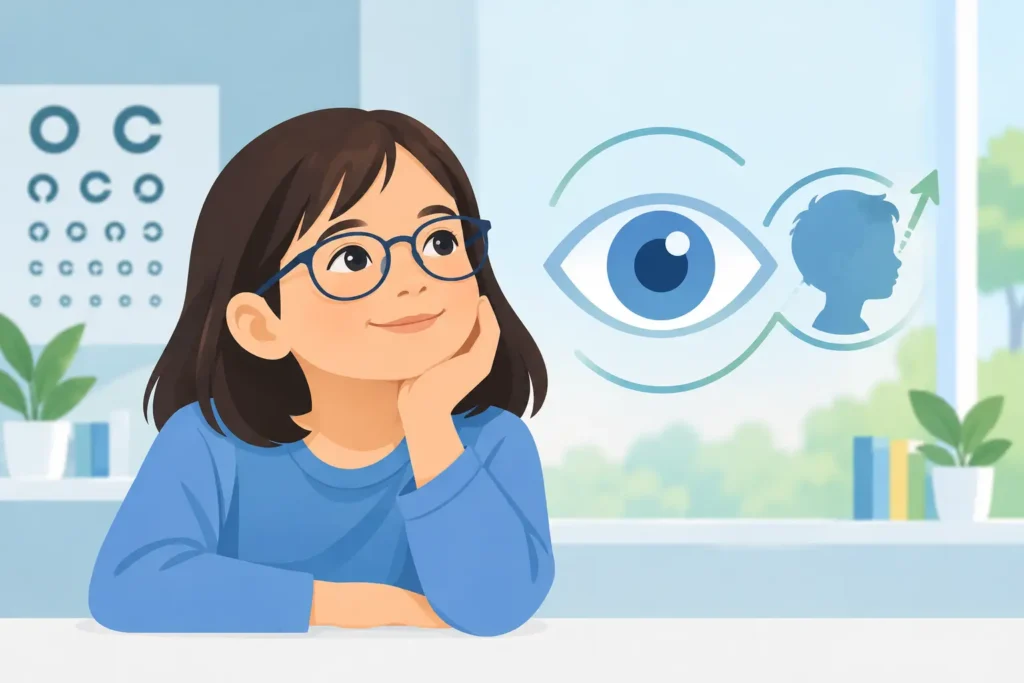
A child who moves closer to the television, loses their place when copying from the board, or starts holding books unusually near may be showing more than a need for new glasses. These can be early signs of myopia, also called nearsightedness. Myopia control for children is a proactive approach that aims to slow the progression of myopia while supporting clear, comfortable vision as a child grows.
For parents, the concern is understandable. A stronger prescription can feel like a routine part of childhood, yet progressive myopia deserves clinical attention. The degree of myopia often changes during school-age years, and higher levels later in life are associated with a greater risk of certain eye conditions. A pediatric eye examination provides the clarity needed to distinguish ordinary visual complaints from a developing refractive concern and to discuss an individualized management plan.
What Myopia Means for a Child’s Eyes
Myopia occurs when light focuses in front of the retina rather than directly on it. This usually happens because the eye grows longer from front to back than expected. Distance vision becomes blurred, while close work may remain clear.
Myopia commonly begins in childhood and may progress through the teenage years, when the eyes and body are still developing. Genetics play a role. A child with one or both parents who are myopic has a higher likelihood of becoming myopic. However, genes are not the whole story. Time spent outdoors, patterns of near work, visual habits, and the age at which myopia begins can all influence the overall picture.
The earlier myopia starts, the more years there may be for it to progress. That does not mean every child will develop high myopia, nor does it mean parents have caused the problem. It does mean that early assessment and regular monitoring can be valuable.
Why Myopia Control for Children Matters
Standard glasses or contact lenses correct blurry distance vision, allowing a child to participate confidently at school, sports, and everyday activities. Myopia-control strategies have a different additional goal: to reduce the rate at which myopia increases over time.
This distinction matters because a prescription is only one measurement. Pediatric ophthalmologists also consider the child’s eye health, visual development, family history, current prescription, rate of change, and, where appropriate, axial length. Axial length measures the physical length of the eye and can offer useful information when tracking myopia progression.
Myopia control is not a promise that progression will stop completely. Response varies among children, and treatment needs can change as they grow. The purpose is thoughtful risk management, supported by scheduled follow-up rather than a one-time prescription update.
Clear Vision Supports Learning and Confidence
Children may not recognize that their distance vision has changed. Some assume everyone sees the classroom board the same way they do. Others compensate by moving closer, squinting, or avoiding activities that require clear distance vision.
When vision is corrected appropriately, children can engage more comfortably in school, play, and social situations. A comprehensive assessment also checks for conditions that can affect visual development, such as amblyopia, eye alignment concerns, or differences in prescription between the two eyes.
How a Specialist Assesses Progressive Myopia
A detailed pediatric eye examination goes beyond reading letters on a chart. The ophthalmologist reviews symptoms, visual demands, family history, prior prescriptions, and the pace of any documented change. The examination may include a cycloplegic refraction, in which eye drops temporarily relax the focusing system to obtain a more accurate measurement of refractive error in children.
The specialist examines the front and back of the eye and evaluates how the eyes work together. Depending on the child’s age and clinical needs, measurements may also be used to establish a baseline for future comparison. This process helps ensure that a treatment recommendation is based on the child’s specific visual and ocular profile.
Parents should bring previous prescriptions or examination records when available. A pattern over time is often more informative than a single prescription reading.
Options That May Be Considered
There is no single myopia-control method that suits every child. The right approach depends on age, the degree and pattern of progression, eye health, maturity, lifestyle, and the family’s ability to follow the recommended care routine.
Specialist-guided options may include specially designed spectacle lenses, multifocal soft contact lenses, overnight orthokeratology lenses, or low-dose atropine eye drops. Each option has practical considerations. Contact lens approaches require consistent hygiene, careful handling, and reliable follow-up. Overnight lenses require particularly close attention to cleaning and wear instructions. Eye drops must be prescribed and monitored by an ophthalmologist, who can assess suitability and watch for side effects.
For some children, conventional glasses and observation remain appropriate, particularly when prescription changes are minimal or the child is not ready for a more involved treatment plan. For others, a myopia-control strategy may be recommended because progression is occurring more quickly or risk factors are present. The decision should be clinical, collaborative, and revisited over time.
Everyday Habits That Support Healthy Visual Development
Lifestyle measures cannot replace an eye examination or prescribed treatment, but they can support a child’s visual health. Outdoor time is consistently associated with a lower likelihood of developing myopia and may be helpful as part of a broader plan. Families can encourage regular outdoor play in a way that fits the child’s interests and daily schedule, with sensible sun protection.
Near work, including reading, homework, and screen use, is a normal part of modern childhood. The goal is not to eliminate it. Instead, encourage a comfortable working distance, good lighting, and regular visual breaks. A child should not need to hold material extremely close or work in dim light to see clearly.
Parents can also watch for changes that warrant an earlier appointment, including frequent squinting, headaches during visual tasks, sitting very close to screens, declining school performance, or reluctance to participate in distance-focused activities. These signs do not confirm myopia on their own, but they are good reasons for a professional assessment.
Follow-Up Is Part of the Treatment
Myopia management is a process, not a single decision. Follow-up appointments allow the ophthalmologist to check vision, review prescription changes, assess tolerance of any treatment, and make adjustments when needed. The timing of visits depends on the child and the selected approach.
Consistency is especially important for children using contact lenses or prescribed eye drops. Parents should contact their eye care team promptly if a child develops eye redness, pain, light sensitivity, discharge, or a sudden change in vision. These symptoms need timely medical evaluation rather than an adjustment made at home.
At Eye Consultants Center, pediatric ophthalmology care is designed to assess the whole child’s visual needs with compassion and clinical precision. For families in Dubai and the UAE, an early specialist evaluation can turn uncertainty about a changing prescription into a clear, practical plan for protecting a child’s vision as their eyes grow.