


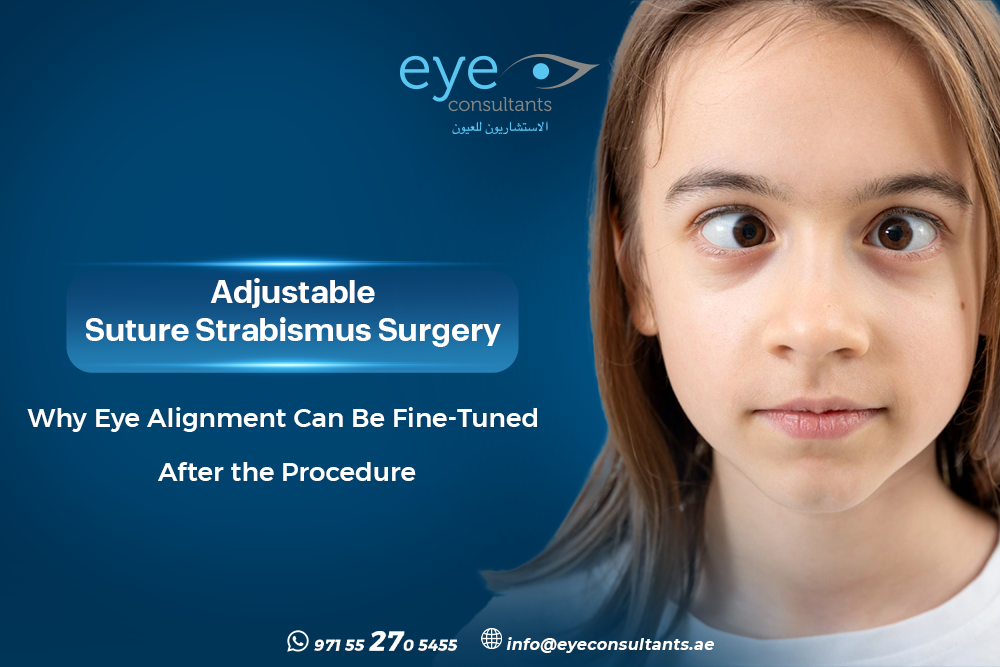
Adjustable suture strabismus surgery allows the surgeon to fine-tune eye alignment after the main muscle procedure has been completed. Instead of relying only on a fixed position, the muscle position can be adjusted during the early postoperative period in selected patients. This can be particularly useful when the final alignment is difficult to predict.
✆ WhatsappHow Does Adjustable Suture Strabismus Surgery Differ From Fixed-Suture Surgery?
Adjustable suture strabismus surgery uses a temporary or sliding knot that allows the position of an extraocular muscle to be modified after surgery. With fixed sutures, the muscle is secured in a predetermined position and cannot be adjusted afterward.
The potential advantage is an additional opportunity to refine alignment when the initial postoperative position is not ideal. However, adjustable sutures are not automatically superior for every patient, and the available evidence does not establish one technique as the best choice for all cases. (Watch this video)
Which Adults May Benefit Most From Adjustable Sutures?
The technique may be considered particularly when postoperative alignment is less predictable. This can include some adults undergoing repeat surgery or those with restrictive or paralytic forms of strabismus.
An adjustable eye muscle surgery approach may be discussed in cases such as:
- Previous strabismus surgery.
- Restrictive or paralytic strabismus.
- Complex eye-muscle conditions.
- Situations where postoperative alignment is difficult to predict.
Studies have reported potential benefits in selected adult groups, particularly some patients undergoing reoperation, although results vary between studies.
What Happens During the Postoperative Adjustment?
The adjustment is performed after the initial muscle surgery when the surgeon can assess the eye position. In adjustable suture strabismus surgery, this allows the surgeon to fine-tune the alignment when needed. Depending on the technique and clinical situation, adjustment may take place in the operating room, several hours afterward, or within the following days.
During an adult squint surgery adjustment, the surgeon evaluates eye alignment and, when appropriate, modifies the muscle position by tightening or loosening the adjustable suture. The exact timing and method depend on the surgical plan and the patient’s condition.
Is the Procedure Comfortable, and What Is Recovery Like?
Comfort and recovery vary depending on the surgical technique, the number of muscles treated, and individual healing. Adjustable suture strabismus surgery may involve temporary eye redness, irritation, or discomfort after the procedure.
The center’s adult squint service states that surgery generally takes around 45 minutes, does not usually require hospital admission, and many patients can return to regular activities within a few days, depending on the procedure and individual recovery.
The goal is not simply to make the eyes appear straight. In adults, treatment may also aim to improve functional alignment and reduce symptoms such as double vision when appropriate.
What Are the Benefits and Limitations?
Adjustable suture strabismus surgery provides an opportunity to refine alignment when the surgeon believes postoperative adjustment may add value. It may be particularly useful in selected complex or repeat cases.
However, it is not required for every patient. Some surgeons achieve excellent alignment with fixed sutures, and research has not consistently demonstrated a definitive advantage of adjustable sutures in every type of strabismus.
Potential benefits may include:
- An opportunity to fine-tune alignment.
- Potential usefulness in unpredictable cases.
- Possible value during selected reoperations.
- A more individualized surgical approach.
In complex cases, the technique may be considered as part of complex strabismus surgery, based on the patient’s anatomy and previous surgical history.
Why Choose Eye Consultants Center?
Adult strabismus can result from previous surgery, trauma, neurological conditions, or thyroid eye disease.
Eye Consultants Center provides specialized adult squint consultations in Dubai with individualized treatment plans.
Both surgical and non-surgical options are considered based on the patient’s condition.
- 14+ years of ophthalmology experience in Dubai.
- Doctors with 30+ years of combined clinical expertise across ophthalmic specialties.
- Dedicated adult squint consultations with individualized treatment plans.
- Assessment of both functional and cosmetic aspects of eye misalignment.
- Surgical and non-surgical options based on each patient’s condition.
- Specialist assessment for patients with previous squint surgery, double vision, or persistent misalignment.
- In selected cases, adjustable sutures may help reduce the need for reoperation for strabismus.
Book your adult strabismus consultation at Eye Consultants Center in Dubai.
Contact us:
or visit Al Razi Building 64, Block C, 1st Floor, Unit 1017 – Dubai Healthcare City – Dubai – United Arab Emirates.
Working Hours:
Monday to Thursday and Saturday: 8 AM to 8 PM
Friday: Closed
Sunday: 9 AM to 8 PM
FAQ’S About Adjustable Suture Strabismus Surgery
Is adjustable suture surgery only for adults?
No. Adjustable sutures can be used in both adults and children, but their use is particularly established in adult strabismus and selected complex cases. The decision depends on the type of deviation, surgical history, and the surgeon’s assessment.
Can adjustable sutures prevent double vision after surgery?
They may help the surgeon refine postoperative alignment, which can be relevant when managing double vision after squint surgery. However, they do not guarantee that double vision will be eliminated, and outcomes vary between patients.
Does every patient need adjustable sutures?
No. The technique is selected according to the patient’s condition and the predictability of the surgical outcome. Many patients can achieve appropriate alignment with conventional fixed sutures.
Conclusion
Adjustable suture strabismus surgery can provide an additional opportunity to fine-tune eye alignment in selected patients. A detailed specialist assessment is essential to determine whether the technique fits the type of strabismus, previous surgical history, and individual treatment goals.
✆ Whatsapp