


Central serous retinopathy treatment depends on how long fluid remains beneath the retina, the severity of vision changes, and whether the condition resolves spontaneously or continues to progress. Many patients notice blurred or distorted central vision in one eye and immediately fear permanent vision loss. However, not every case requires immediate intervention. A comprehensive retinal examination, combined with advanced imaging, allows retina specialists to determine whether observation is appropriate or whether treatment should begin. Understanding this process helps patients make informed decisions and seek care at the right time.
Central serous retinopathy treatment: What Is It and Why Does It Affect Central Vision?
Before choosing the appropriate management, it is important to understand the condition itself.
Central serous chorioretinopathy (CSR), also known as CSR eye disease, occurs when fluid under the macula accumulates because of leakage from the choroid through the retinal pigment epithelium. Since the macula is responsible for detailed central vision, even a small amount of fluid can affect daily activities such as reading, driving, and using digital devices.
When evaluating central serous retinopathy treatment, retina specialists consider:
- The amount and location of fluid under the macula.
- Whether the episode is acute or chronic.
- The duration of symptoms.
- Visual acuity and OCT findings.
- Whether this is a first episode or a recurrence.
Many first-time episodes improve without intervention, while persistent disease may require central serous chorioretinopathy treatment based on careful clinical evaluation. (Watch this video)
What Are the Typical Symptoms of CSR Eye Disease?
Patients often notice visual changes that develop over several days rather than suddenly.
Common symptoms include:
- Blurry central vision in one eye.
- Distorted straight lines (metamorphopsia).
- Objects appearing smaller than normal (micropsia).
- A gray or dark spot in the center of vision.
- Reduced contrast sensitivity.
- Difficulty reading fine print.
Although blurry central vision stress retina is a phrase commonly searched online, stress alone does not confirm the diagnosis. Similar symptoms may occur with several retinal disorders, making specialist examination essential before determining the appropriate central serous retinopathy treatment.
How Are Stress, Steroids, and Other Risk Factors Related to Central Serous Retinopathy?
The exact cause of CSR is still being studied, but several risk factors have been consistently associated with the disease.
Retina specialists commonly evaluate:
- Emotional or psychological stress.
- Corticosteroid use (oral, injectable, inhaled, topical, or nasal).
- High-stress occupations.
- Sleep disturbances.
- Previous episodes of CSR.
- Certain medical conditions affecting vascular regulation.
Because both stress and corticosteroid exposure may contribute to disease activity, these factors are reviewed carefully before deciding whether observation or central serous chorioretinopathy treatment is appropriate.
When Is Central Serous Retinopathy Treatment Necessary Instead of Observation?
One of the most important questions patients ask is whether treatment is always required.
For many patients with a first episode, careful observation is reasonable because the fluid under the macula often resolves spontaneously over several weeks or months.
However, retina intervention may be considered when:
- Fluid persists beyond the expected recovery period.
- Vision continues to deteriorate.
- OCT demonstrates persistent retinal changes.
- Recurrent episodes develop.
- Daily activities become significantly affected.
Rather than following a single treatment pathway, retina specialists individualize central serous retinopathy treatment according to imaging findings, symptom duration, occupational needs, and the patient’s overall clinical picture.
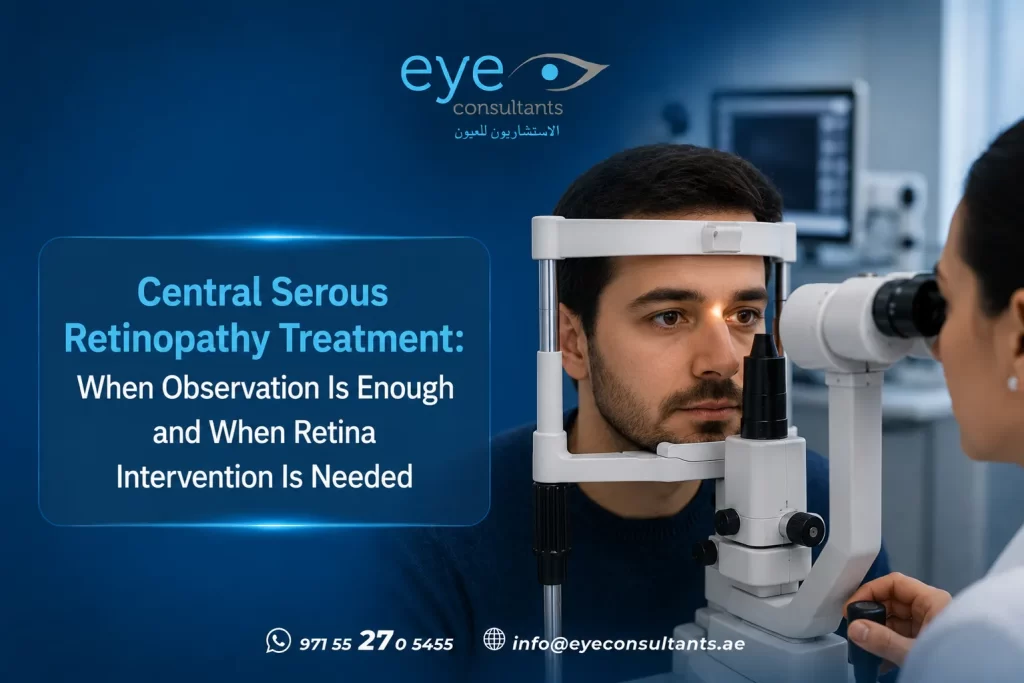
Which Imaging Tests Guide Central Serous Retinopathy Treatment and Follow-Up?
Symptoms alone cannot determine the severity of the disease.
Comprehensive retinal imaging allows ophthalmologists to monitor disease activity and guide treatment decisions.
Investigations with advanced techniques commonly include:
- Optical Coherence Tomography (OCT).
- OCT Angiography when indicated.
- Fluorescein angiography in selected patients.
- Comprehensive dilated retinal examination.
- Visual acuity assessment.
These investigations help quantify fluid under the macula, monitor recovery over time, and determine whether ongoing observation or central serous retinopathy treatment offers the most appropriate management strategy. (Watch also)
Why Choose Eye Consultants Dubai?
Managing vitreoretinal disease requires experienced retina specialists and advanced diagnostic technology to ensure accurate diagnosis and individualized treatment planning. At Eye Consultants Center, patients benefit from:
- More than 14 years of excellence in ophthalmology.
- Consultant ophthalmologists with over 30 years of combined clinical experience.
- Dedicated vitreoretinal specialists experienced in diagnosing and managing CSR and other retinal diseases.
- Advanced retinal artery imaging, including OCT and comprehensive diagnostic investigations.
- Personalized treatment and follow-up plans based on each patient’s clinical findings.
If you have blurry central vision, distorted images, or have been diagnosed with CSR eye disease, early evaluation can determine whether observation is appropriate or whether central serous retinopathy treatment should be considered.
Book your appointment today.
Contact us:
or visit Al Razi Building 64, Block C, 1st Floor, Unit 1017 – Dubai Healthcare City – Dubai – United Arab Emirates.
Working Hours:
Monday to Thursday and Saturday: 8 AM to 8 PM
Friday: Closed
Sunday: 9 AM to 8 PM
Frequently Asked Questions
Does every patient need central serous retinopathy treatment?
No. Many patients with a first episode recover naturally as the fluid under the macula gradually resolves. However, persistent, recurrent, or visually significant cases may require central serous chorioretinopathy treatment after evaluation by a retina specialist.
Can stress cause CSR eye disease?
Stress has been associated with CSR eye disease, although it is not the only contributing factor. Retina specialists also evaluate steroid use, medical history, and retinal imaging before determining whether stress may have played a role.
Is blurry central vision always caused by CSR?
No. Blurry central vision may result from several retinal conditions, including macular degeneration and diabetic retinal disease. A comprehensive retinal examination and OCT imaging are necessary to establish the correct diagnosis.
Which imaging test is most useful for monitoring CSR?
Optical Coherence Tomography (OCT) is one of the most valuable investigations because it clearly demonstrates fluid under the macula and allows retina specialists to monitor disease progression and response over time.
Can CSR return after recovery?
Yes. Some patients experience recurrent episodes months or years after the initial event. Regular follow-up enables retina specialists to detect recurrence early and determine whether additional central serous retinopathy treatment is required.
Central serous retinopathy treatment should always be guided by accurate diagnosis rather than symptoms alone. While many acute cases improve with observation, persistent or recurrent CSR eye disease may require central serous chorioretinopathy treatment based on detailed retinal imaging and specialist evaluation.