


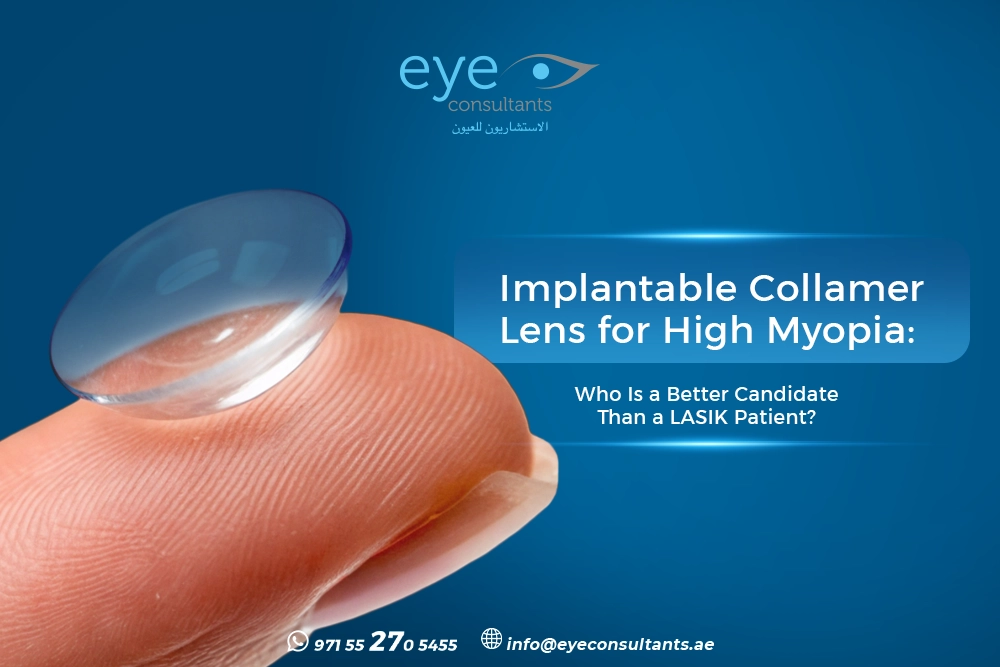
Implantable collamer lens for high myopia may be a better vision correction option for people who have severe nearsightedness or corneas that are too thin for laser procedures. If you’ve been told you’re not an ideal LASIK candidate, that doesn’t necessarily mean you’re out of options. A comprehensive refractive assessment can identify whether an implantable lens provides a safer and more suitable alternative for your eyes. Understanding the differences is the first step toward making an informed decision.
What an Implantable collamer lens for high myopia is and how it differs from laser correction
The implantable collamer lens for high myopia is a soft, biocompatible lens placed inside the eye, behind the iris and in front of the natural lens. Unlike LASIK or other laser procedures, it does not reshape the cornea. Instead, it corrects refractive error by adding a permanent lens while preserving the eye’s natural structures.
The main differences include:
| Implantable Collamer Lens (ICL) | Laser Vision Correction |
| Adds a lens inside the eye | Reshapes the cornea |
| Suitable for very high myopia | Best for selected refractive ranges |
| Preserves corneal tissue | Removes corneal tissue |
| Can be removed or exchanged if medically indicated | Corneal changes are permanent |
For patients researching ICL vs laser vision correction, the most appropriate option depends on detailed eye measurements rather than prescription alone.
Which high-myopia or thin-cornea patients may prefer ICL-type solutions
Not everyone seeking freedom from glasses is an ideal laser candidate. For carefully selected individuals, implantable collamer lens for high myopia may offer a suitable alternative when standard laser vision correction is not recommended. In some situations, ICL for severe nearsightedness may provide a more appropriate solution after specialist evaluation.
Your ophthalmologist may discuss a lens implant for high myopia if you have:
- Moderate to very high myopia.
- Thin corneas that may not safely support laser reshaping.
- Stable vision prescription.
- Healthy natural eye lens.
- No eye disease that would make intraocular surgery unsuitable.
The final decision always depends on a comprehensive examination rather than a single measurement. (Watch also)
Pre-op testing and how surgeons decide candidacy
Choosing the right refractive procedure starts with careful diagnostics. At Eye Consultants, refractive surgeons perform a comprehensive evaluation using advanced diagnostic technology before recommending any procedure.
The assessment commonly includes:
- Corneal topography and tomography.
- Corneal thickness measurement.
- Anterior chamber depth evaluation.
- Pupil size assessment.
- Stable refraction testing.
- Comprehensive retinal examination.
- General eye health assessment.
These findings help determine whether implantable collamer lens for high myopia or another refractive lens extraction procedure offers the safest approach.
Benefits, trade-offs, and common patient questions about reversibility and night vision
Every refractive procedure offers advantages and limitations. Understanding both helps patients make realistic decisions.
Potential advantages
- Excellent correction for high levels of myopia.
- Preserves corneal tissue.
- High-quality visual outcomes for appropriately selected patients.
- The implanted lens can be removed or exchanged if medically necessary.
Important considerations
- It is an intraocular surgical procedure.
- Temporary glare or halos at night may occur in some patients, particularly during the early recovery period.
- Regular postoperative follow-up remains important for long-term eye health.
Like all vision correction procedures, results vary between individuals and depend on careful patient selection.
Recovery timeline, follow-up visits, and long-term monitoring
After receiving an implantable collamer lens for high myopia, most patients notice visual improvement within the first few days after surgery, although complete stabilization varies from person to person. Implantable collamer lens recovery generally involves scheduled follow-up visits to monitor healing, assess vision, and ensure the implanted lens remains correctly positioned.
Your surgeon may recommend:
- Examination within the first day after surgery.
- Additional visits during the following weeks.
- Periodic long-term monitoring of eye pressure, lens position, and overall eye health.
Following postoperative instructions carefully and attending all scheduled follow-up appointments supports a smooth recovery and allows your ophthalmologist to monitor your long-term eye health.
Why choose Eye Consultants?
Eye Consultants Center provides comprehensive refractive surgery services in Dubai Healthcare City, supported by experienced consultant ophthalmologists and advanced diagnostic technology.
The center offers multiple vision correction options including Phakic IOL (ICL), Femto LASIK, SMILE, PRK, Contoura Vision, and Refractive Lens Extraction allowing treatment recommendations to be tailored to each patient’s eye condition rather than applying a single solution. (Watch this video)
Patients also benefit from:
- Consultant ophthalmologists with extensive experience in corneal and refractive surgery.
- Modern diagnostic equipment for precise preoperative evaluation.
- Personalized treatment planning.
- Comprehensive postoperative follow-up.
- Convenient location in Dubai Healthcare City.
Book your appointment today with Eye Consultants for a comprehensive evaluation by our experienced consultant ophthalmologists.
Contact us:
or visit Al Razi Building 64, Block C, 1st Floor, Unit 1017 – Dubai Healthcare City – Dubai – United Arab Emirates.
Working Hours:
Monday to Thursday and Saturday: 8 AM to 8 PM
Friday: Closed
Sunday: 9 AM to 8 PM
FAQ
Is implantable collamer lens for high myopia permanent?
The implanted lens is designed to remain in the eye long term. However, unlike laser procedures, it can be removed or exchanged if medically necessary. Whether this option is suitable depends on the findings of a detailed eye examination.
Is ICL better than LASIK?
Neither procedure is universally better. ICL vs laser vision correction depends on factors such as prescription, corneal thickness, eye anatomy, lifestyle, and overall ocular health. A refractive surgeon determines the most appropriate option after comprehensive testing.
Can patients with thin corneas have ICL surgery?
Yes, patients with thin corneas who are not suitable for laser procedures may still qualify for implantable collamer lens for high myopia, provided the rest of the eye meets the required safety criteria during evaluation.
How long does implantable collamer lens recovery take?
Many patients experience improved vision within days, while visual stabilization continues over several weeks. Recovery speed differs between individuals, making scheduled follow-up visits an essential part of postoperative care.
For patients with severe myopia or corneas that may not be suitable for lasik treatment, implantable collamer lens for high myopia offers an important alternative that preserves corneal tissue while providing effective refractive correction. The most appropriate treatment can only be determined after a comprehensive ophthalmic assessment, making an early consultation the best first step toward choosing the right vision correction solution.