


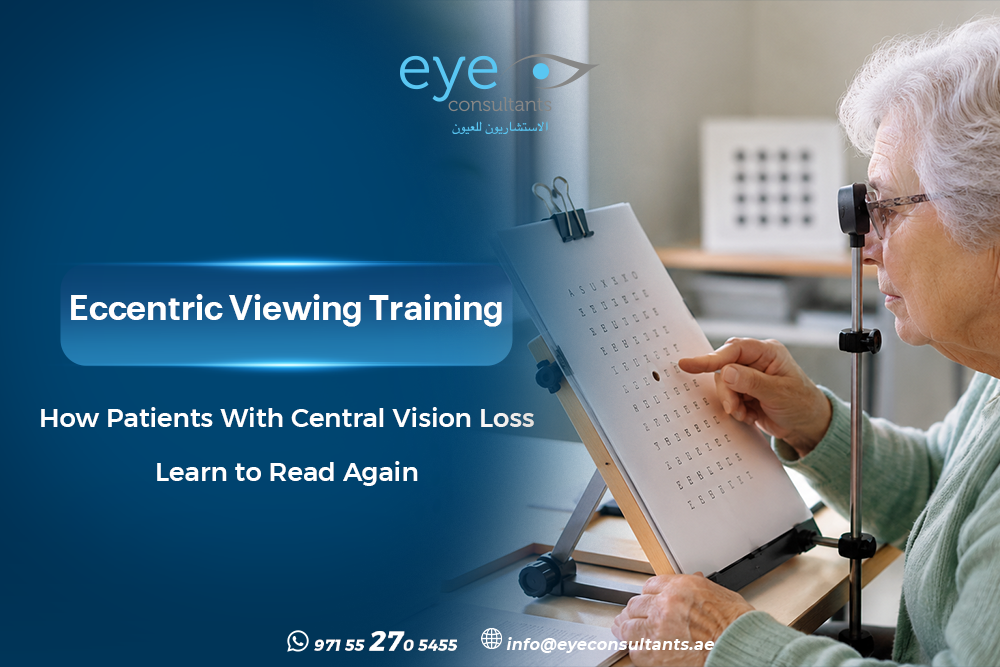
Eccentric viewing training can help some people with central vision loss use a healthier area of the retina for tasks such as reading. Instead of looking directly at a damaged central area, patients learn to use a slightly different point of fixation.
This approach is part of low-vision rehabilitation and focuses on practical visual goals, not simply increasing visual acuity.
Why Central Vision Loss Makes Reading Difficult: The Role of Eccentric Viewing Training
Eccentric viewing training may be considered when central retinal damage makes it difficult to see fine details, letters, or words clearly, even when peripheral vision remains useful.
A central scotoma can make parts of words appear missing or blurred and may make it harder to follow lines while reading.
For this reason, low-vision assessment considers practical daily visual needs, not just standard eye-chart results. (Watch this)
- Reading books, newspapers, and labels
- Using a smartphone or computer
- Recognizing faces and objects
- Managing everyday visual tasks
What a Preferred Retinal Locus Is and How It Is Found
A preferred retinal locus (PRL) is an area outside the damaged central region that a person may use for fixation when the fovea cannot provide a clear image.
Some patients develop a PRL naturally, while others may benefit from guidance to use it more consistently.
Assessment considers fixation, remaining vision, and daily visual needs to determine whether an alternative fixation strategy may help.
Training Strategies for Reading, Phone Use, and Daily Tasks
Eccentric viewing training focuses on helping the patient direct their gaze toward a usable retinal area instead of relying on the damaged center.
Training may include:
- Practicing fixation on individual letters or words
- Progressing from short words to longer lines of text
- Learning controlled eye movements while reading
- Practicing with phones, tablets, or other screens
- Combining the strategy with appropriate magnification and lighting
This low vision reading training is tailored to the patient’s remaining vision and daily goals. While some patients may learn eccentric fixation strategies, results can vary, and evidence does not show a consistent benefit for everyone.
Who May Benefit AMD, Central Scars, Inherited Macular Disease, and Stable Retinal Conditions
Eccentric viewing training may be considered for selected patients with conditions that affect central vision, particularly when the underlying retinal condition is stable enough for rehabilitation goals to be assessed.
Potential situations include:
- Age-related macular degeneration (AMD) (Watch this)
- Central retinal or macular scars
- Inherited macular diseases
- Other stable conditions causing a central scotoma
The suitability of macular degeneration rehabilitation depends on the retinal damage, remaining vision, fixation stability, and daily needs. It aims to help patients make better use of their remaining vision rather than reverse the underlying disease.
Combining Training With Magnifiers, Lighting, and Electronic Aids
Eccentric viewing training does not necessarily replace visual aids. In many cases, rehabilitation combines a fixation strategy with tools that make the target easier to see.
Depending on the task, these may include:
- Hand or stand magnifiers
- Electronic magnification
- Larger text and screen settings
- Higher contrast
- Improved lighting and glare control
- Read-aloud functions on digital devices
Low vision may require magnifiers, electronic aids, or high-powered spectacles rather than standard glasses. The rehabilitation approach focuses on matching these aids to daily tasks and teaching patients how to use them effectively.
Why Choose Eye Consultants Center?
Eye Consultants Center provides a dedicated Contact Lenses and Low Vision service that includes assessment of low vision and guidance on suitable visual aids. The center’s approach focuses on evaluating functional vision and selecting practical solutions according to each patient’s needs.
With 14 years of clinical experience and ophthalmologists with more than 30 years of experience across multiple eye-care subspecialties, the center combines specialist eye care with advanced ophthalmic technology and patient-focused support. It is located in Dubai Healthcare City. (Watch also)
Book your appointment now at Eye Consultants center for a comprehensive assessment by our team of ophthalmology consultants.
Contact us
or visit Al Razi Building 64, Block C, 1st Floor, Unit 1017 – Dubai Healthcare City – Dubai – United Arab Emirates.
FAQ’S
Can eccentric viewing training help with reading?
It may help some patients develop a more effective fixation strategy when central vision is impaired. Results vary, so assessment is needed to determine whether it is appropriate.
What is the difference between low vision therapy and regular glasses?
Low vision therapy helps patients use their remaining vision for daily activities through visual strategies, magnification, lighting, and electronic aids, not simply stronger glasses.
Does eccentric viewing training restore central vision?
No. It does not restore damaged retinal tissue or reverse the underlying condition. Its goal is to help patients make better use of their remaining peripheral vision.
When should someone consider low-vision rehabilitation?
It may be appropriate when vision loss affects reading, phone use, medication labels, household tasks, or other daily activities. Early assessment can help identify suitable rehabilitation options.
Conclusion
Eccentric viewing training can be one part of a personalized rehabilitation plan for people with central vision loss. With appropriate assessment, patients may learn alternative ways to use their remaining vision for reading and daily activities, alongside suitable visual aids when needed.