


Gonioscopy test for glaucoma is a specialized eye examination that helps ophthalmologists evaluate the eye’s drainage angle, an area that cannot be assessed through routine eye pressure measurements alone. If you have been told that your eye pressure is elevated or that glaucoma is suspected, this test may provide essential information that changes the diagnosis and guides the next steps in your care. Understanding its role can help you appreciate why a comprehensive glaucoma evaluation goes beyond measuring eye pressure.
What Is a Gonioscopy Test for Glaucoma and What Does the Drainage Angle Reveal?
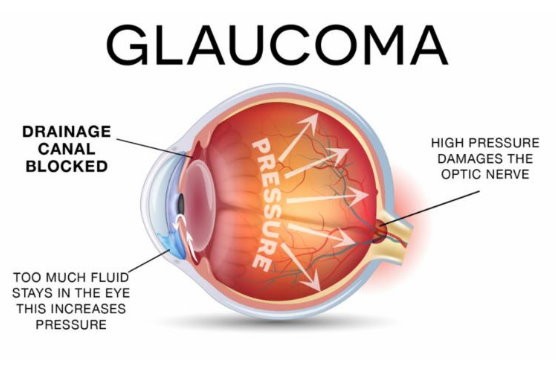
A gonioscopy test for glaucoma allows an ophthalmologist to directly examine the drainage angle, where the iris meets the cornea and aqueous fluid exits the eye.
This drainage angle exam helps determine how efficiently fluid can leave the eye and whether anatomical changes may increase the risk of glaucoma.
During the examination, the specialist evaluates whether the drainage angle is:
- Completely open.
- Narrow and at risk of closing.
- Partially blocked.
- Completely closed.
- Affected by abnormal pigmentation, scar tissue, or new blood vessels.
These findings provide valuable information that cannot be obtained from eye pressure measurements alone and often influence the overall glaucoma evaluation. (Watch this video)
Why Glaucoma Is Not Diagnosed by Eye Pressure Alone
Many patients assume that glaucoma is diagnosed simply because eye pressure is high. In reality, pressure is only one part of a much larger assessment.
Some individuals develop optic nerve damage despite normal eye pressure, while others have ocular hypertension without glaucoma.
A comprehensive glaucoma assessment may include:
- Eye pressure measurement.
- Optic nerve examination.
- Optical Coherence Tomography (OCT).
- Visual field testing.
- Gonioscopy test for glaucoma to evaluate the drainage angle.
Combining these findings allows ophthalmologists to distinguish between different glaucoma conditions and identify patients who require closer monitoring.
How a Gonioscopy Test for Glaucoma Distinguishes Open-Angle and Narrow-Angle Disease
One of the greatest advantages of a gonioscopy test for glaucoma is its ability to identify the anatomical type of glaucoma.
| Drainage Angle Finding | Clinical Significance |
| Open angle | Fluid can reach the drainage system, although glaucoma may still occur if the optic nerve is damaged. |
| Narrow angle | The drainage pathway is crowded and may close unexpectedly, increasing the risk of angle-closure glaucoma. |
| Closed angle | Fluid drainage becomes obstructed and requires prompt ophthalmic evaluation. |
Because management differs depending on the drainage angle, gonioscopy for angle closure is considered an important part of the diagnostic workup whenever angle-closure glaucoma is suspected.
When Is a Gonioscopy Test for Glaucoma Especially Important?
Certain symptoms and examination findings make this test particularly valuable.
Your ophthalmologist may recommend a gonioscopy test for glaucoma if you experience:
- Halos around lights.
- Eye pain.
- Sudden headaches associated with blurred vision.
- Elevated or fluctuating eye pressure.
- A family history of glaucoma.
- Suspicious findings during a routine eye examination.
A narrow angle glaucoma test is also commonly performed before certain procedures or when the anatomy of the front part of the eye suggests a higher risk of angle closure. (Watch also)
What Happens During the Test and Does It Hurt?
Although the name sounds complex, the examination is simple and usually takes only a few minutes.
Before the test:
- Numbing eye drops are applied.
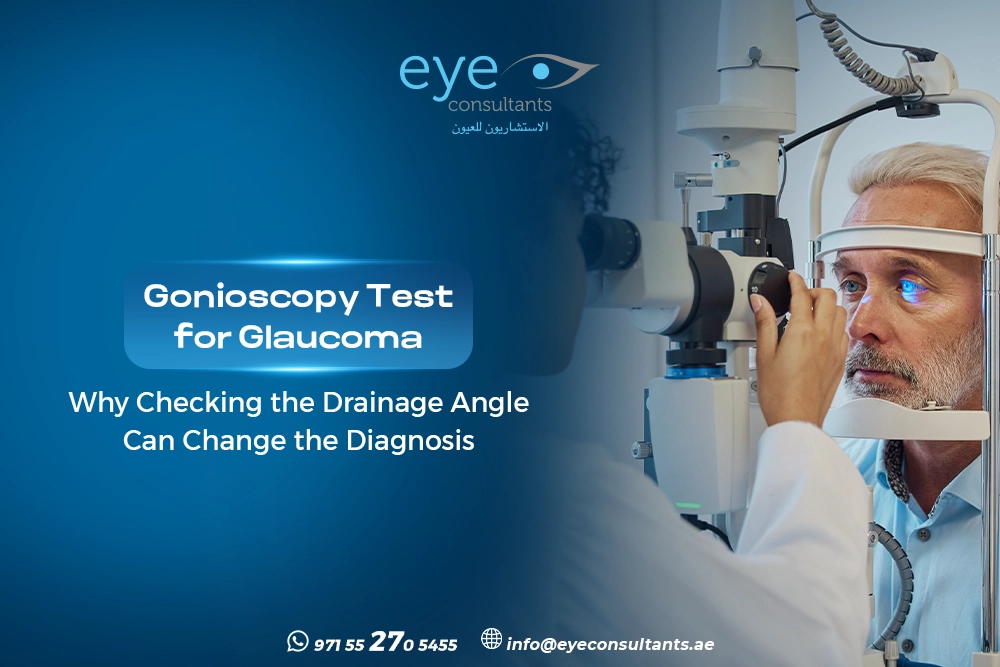
- A small mirrored lens is gently placed on the eye.
- The ophthalmologist examines the drainage angle using a slit lamp microscope.
Most patients feel only mild pressure rather than pain.
The lens does not damage the eye, and patients can usually resume their normal daily activities shortly after the examination unless additional diagnostic tests are planned.
Why Choose Eye Consultants Center?
Accurate glaucoma diagnosis depends on specialist expertise and advanced diagnostic technology. At Eye Consultants Center in Dubai Healthcare City, patients benefit from:
- More than 14 years of excellence in ophthalmic care.
- Consultant ophthalmologists with extensive experience across multiple subspecialties, including glaucoma.
- Advanced diagnostic equipment for detailed glaucoma angle assessment and comprehensive glaucoma evaluation.
- Personalized care plans based on each patient’s individual clinical findings.
- Continuous follow-up to monitor disease progression and support long-term eye health.
Patients who require further evaluation can also explore the center’s dedicated Glaucoma Treatment service to understand the available diagnostic and management options.
Early Diagnosis Starts with the Right Examination
Book your appointment today at Eye Consultants Center for a comprehensive glaucoma assessment performed by our consultant ophthalmologists.
Contact us
or visit Al Razi Building 64, Block C, 1st Floor, Unit 1017 – Dubai Healthcare City – Dubai – United Arab Emirates.
Working Hours:
Monday to Thursday and Saturday: 8 AM to 8 PM
Friday: Closed
Sunday: 9 AM to 8 PM
Frequently Asked Questions
Is a gonioscopy test for glaucoma painful?
No. Most patients experience only slight pressure after anesthetic eye drops are applied. The examination is brief, does not require surgery, and is generally well tolerated.
Can gonioscopy diagnose glaucoma by itself?
No. Gonioscopy is one component of a complete glaucoma assessment. Your ophthalmologist interprets its findings together with optic nerve evaluation, OCT imaging, visual field testing, and intraocular pressure measurements.
Why is a gonioscopy test for glaucoma necessary if my eye pressure is normal?
Normal eye pressure does not always rule out glaucoma. This examination evaluates the drainage angle and may identify anatomical features associated with glaucoma risk even when pressure readings appear normal.
Who should undergo a drainage angle exam?
Patients with elevated eye pressure, suspected glaucoma, recurrent eye pain, halos around lights, shallow anterior chambers, or a family history of glaucoma may benefit from a drainage angle exam as part of their evaluation.
Is gonioscopy used only for angle-closure glaucoma?
No. Although gonioscopy for angle closure is one of its most common uses, the examination is valuable in many glaucoma cases because it provides important information about the anatomy of the drainage system.
Conclusion
A gonioscopy test for glaucoma provides information that routine eye pressure measurements cannot reveal. By carefully examining the drainage angle, ophthalmologists can distinguish between different forms of glaucoma and recommend the most appropriate diagnostic pathway. Early specialist evaluation plays an essential role in protecting vision and ensuring that treatment decisions are based on a complete clinical assessment.