


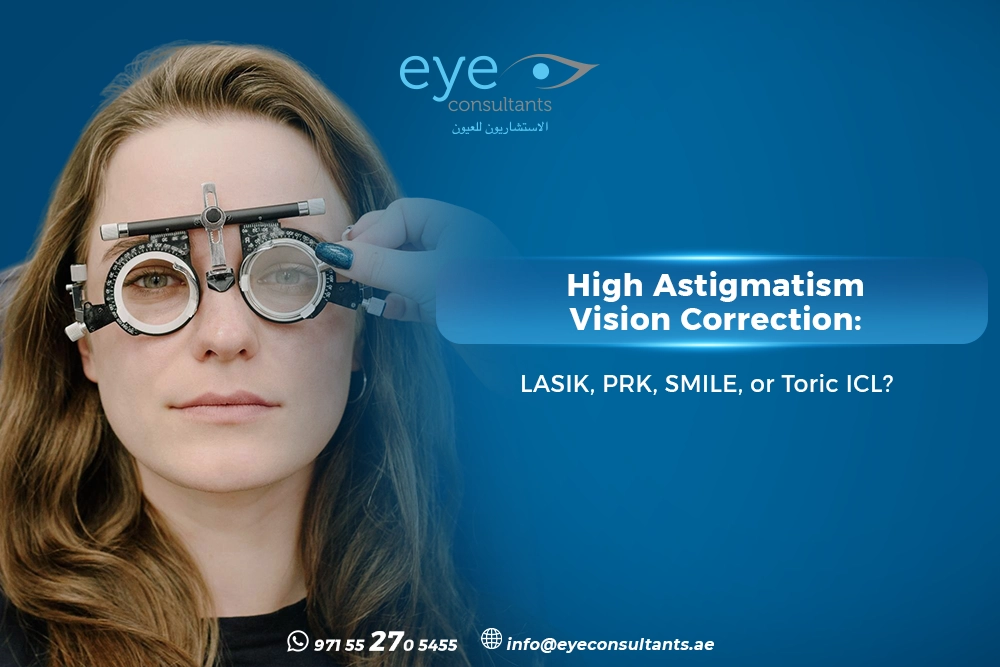
High astigmatism vision correction requires careful planning rather than choosing a procedure based only on the glasses prescription. The right option depends on the type and degree of astigmatism, corneal shape, thickness, eye health, and prescription stability.
High Astigmatism Vision Correction: What Counts as High Astigmatism?
There is no single cutoff that defines “high” astigmatism for every procedure. Higher prescriptions may require more detailed assessment because treatment must correct the refractive error while maintaining corneal safety.
During an assessment for high astigmatism vision correction, your ophthalmologist may consider:
- The amount and type of astigmatism
- Whether the astigmatism is regular or irregular
- Corneal shape and thickness (Watch this video)
- Stability of the prescription
- Overall eye health
- Previous eye conditions or surgeries
- Your visual needs and expectations
Corneal Shape, Thickness, and Stability Checks
Before considering high astigmatism vision correction, several measurements help determine whether laser or lens-based treatment is appropriate.
Important tests may include:
- Visual acuity testing
- Detailed refraction
- Corneal topography or tomography
- Corneal thickness measurement
- Tear film and ocular surface evaluation
- Assessment of prescription stability
- Complete eye examination
Corneal topography astigmatism assessment is particularly useful for identifying irregular corneal patterns and conditions such as keratoconus that may affect refractive surgery planning.
Laser Options and Their Limitations
Different types of astigmatism laser eye surgery may be considered depending on your measurements.
LASIK for High Astigmatism
LASIK for high astigmatism reshapes the cornea to reduce astigmatism and other refractive errors.
It may be considered when:
- The corneal shape is suitable
- Corneal thickness is adequate
- The prescription is stable
- There are no significant contraindications
Customized treatments such as Contoura Vision may also be considered in selected cases.
PRK for Astigmatism
PRK for astigmatism reshapes the corneal surface without creating a LASIK flap.
It may be considered when:
- Surface laser treatment is more appropriate
- Corneal characteristics need to be taken into account
- The patient is otherwise suitable for refractive surgery
SMILE
SMILE can correct myopia with astigmatism in suitable patients. However, its suitability depends on the specific refractive error and available treatment parameters.
Toric ICL and Lens-Based Alternatives
For some patients, laser treatment may not be the preferred option. A toric ICL is a phakic intraocular lens designed to correct myopia with astigmatism while leaving the natural lens in place.
A toric ICL may be considered based on:
- The patient’s refractive prescription
- Corneal measurements
- Anterior chamber anatomy
- Overall eye health
- Age and individual needs
Other lens-based procedures, such as refractive lens exchange, may also be considered for selected patients.
Therefore, high astigmatism vision correction should be based on a complete eye assessment rather than the prescription alone. (Watch also)
Night Vision, Glare, and Realistic Expectations
Before high astigmatism vision correction, patients should understand that visual outcomes can vary.
Possible symptoms after refractive surgery may include:
- Dry eye symptoms
- Glare
- Halos around lights
- Changes in night vision
- Temporary fluctuations in vision
A detailed assessment allows the surgeon to discuss these factors and set realistic expectations before treatment.
Why Choose Eye Consultants Center?
Eye Consultants Center provides refractive surgery assessment for patients considering different vision correction options. The refractive team has experience with:
- LASIK
- Femto-LASIK
- PRK
- SMILE
- Contoura Vision
- Phakic IOL procedures
The appropriate treatment is determined after evaluating the patient’s individual corneal and refractive measurements.
Ready to Explore Your Options?
Don’t choose a vision correction procedure based on your prescription alone.
Book a refractive surgery assessment at Eye Consultants Dubai and let our specialists evaluate your cornea, vision, and eye health to determine the options suitable for you.
Contact us
or visit Al Razi Building 64, Block C, 1st Floor, Unit 1017 – Dubai Healthcare City – Dubai – United Arab Emirates.
FAQ’S
How do I know which treatment is suitable?
A comprehensive refractive assessment is needed to determine the appropriate high astigmatism vision correction option for your eyes.
Can LASIK correct high astigmatism?
LASIK can correct astigmatism in suitable patients. Eligibility depends on the prescription, corneal measurements, stability, and overall eye health.
Is PRK suitable for high astigmatism?
PRK for astigmatism may be considered for selected patients when surface laser treatment is appropriate.
What is a toric ICL?
A toric ICL is an implanted phakic lens designed to correct myopia with astigmatism while preserving the natural lens.
Conclusion
High astigmatism vision correction starts with the right diagnosis and a detailed assessment. LASIK, PRK, SMILE, or toric ICL may be suitable depending on your eyes and prescription.