


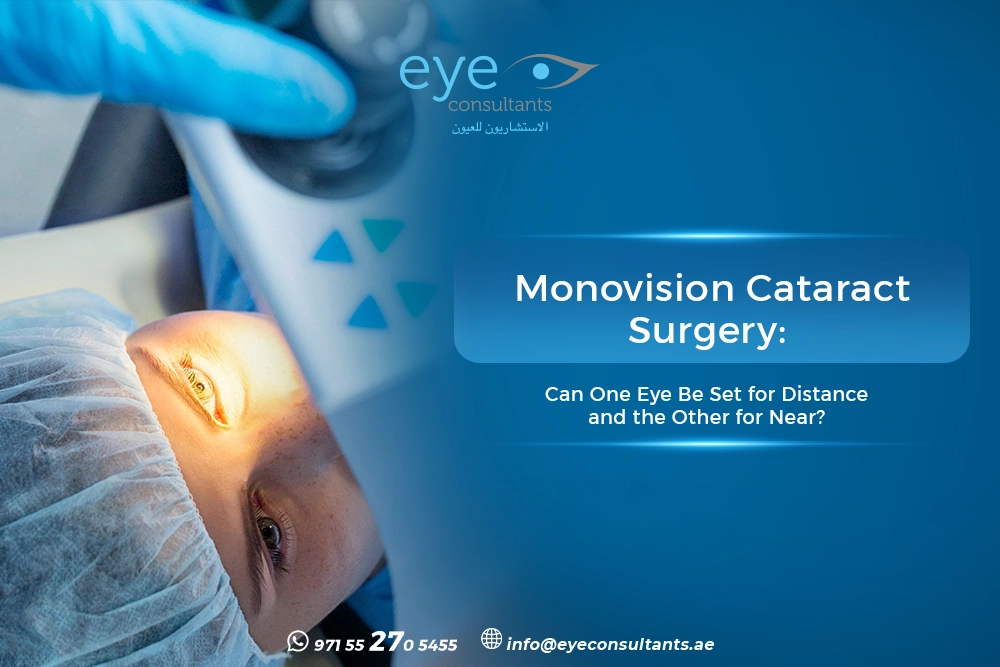
Monovision cataract surgery may be an option for patients who want greater visual independence after cataract surgery. Instead of correcting both eyes for the same distance, one eye is focused on distance vision while the other is set for near vision. Whether this approach is suitable depends on detailed preoperative testing, lifestyle needs, and how well the brain adapts. Understanding your options can help you make an informed decision before surgery.
What is monovision cataract surgery?
Monovision cataract surgery reduces dependence on glasses by assigning different focusing roles to each eye. The dominant eye is usually corrected for distance, while the other supports near tasks such as reading vision after cataract surgery.
This monovision lens strategy uses monofocal intraocular lenses rather than multifocal lenses. During cataract surgery lens planning, your ophthalmologist evaluates:
- Eye dominance
- Daily visual needs
- Refractive error
- Overall eye health
- Patient expectations
The final recommendation is always based on a comprehensive eye examination.
Which patients adapt well and who may struggle with imbalance or depth perception
Many patients adapt successfully, while others may notice reduced depth perception or imbalance.
Patients who often adapt well:
- Previous monovision contact lens users
- Those wishing to reduce reading glasses
- People with realistic expectations
Patients who may find it challenging:
- Frequent night drivers
- Those needing precise depth perception
- Patients with other eye conditions
A detailed evaluation helps determine whether monovision cataract surgery is appropriate.
How monovision compares with multifocal, EDOF, and toric strategies
| Strategy | Primary Goal |
| Monovision | One eye for distance, one for near |
| Multifocal IOL | Multiple viewing distances |
| EDOF IOL | Extended range of vision |
| Toric IOL | Astigmatism correction |
Each option has different advantages, and the most suitable choice depends on your eye measurements, lifestyle, and expectations.
Trial methods and discussions surgeons use before final lens selection
Choosing the right lens strategy requires more than measuring cataracts. Before recommending monovision cataract surgery, your surgeon evaluates:
- Eye dominance
- Corneal measurements
- Retinal health
- Astigmatism
- Lifestyle needs
- Previous monovision experience, if applicable
This personalized assessment helps match the lens strategy to your visual goals. (Watch this video)
What can daily life feel like after surgery with Monovision Cataract Surgery?
Many patients enjoy greater freedom from glasses after adapting to monovision, although experiences vary. Some may still use glasses for prolonged reading or certain distance activities.
Adapting to one eye for distance one for near after cataract surgery usually takes time, and regular follow-up visits help monitor healing and visual performance. (Watch also)
Why Choose Eye Consultants?
At Eye Consultants Center, cataract treatment begins with a comprehensive eye examination and personalized lens planning.
Patients benefit from:
- Experienced consultant ophthalmologists
- Advanced diagnostic technology
- Multiple intraocular lens options
- Personalized treatment plans
- Comprehensive postoperative follow-up
- Convenient location in Dubai Healthcare City
Book your appointment today with Eye Consultants Center for a comprehensive cataract evaluation and personalized lens consultation by our experienced consultant ophthalmologists. (Watch this video)
Contact us:
or visit Al Razi Building 64, Block C, 1st Floor, Unit 1017 – Dubai Healthcare City – Dubai – United Arab Emirates.
Working Hours:
Monday to Thursday and Saturday: 8 AM to 8 PM
Friday: Closed
Sunday: 9 AM to 8 PM
FAQ’S
Can monovision cataract surgery eliminate the need for glasses?
Monovision cataract surgery can reduce dependence on glasses for many daily activities, although some patients may still need them for prolonged reading or night driving. Results vary according to individual adaptation and visual needs.
Is monovision better than multifocal lenses?
Neither option is suitable for everyone. A monovision lens strategy may benefit some patients, while multifocal lenses may better suit others. The best choice depends on a comprehensive eye evaluation.
Will I lose depth perception with monovision?
Some patients notice mild changes in depth perception because each eye focuses differently. Many adapt well over time, but individual experiences vary.
Can I try monovision before cataract surgery?
When appropriate, your ophthalmologist may recommend a contact lens trial to simulate monovision before surgery and support cataract surgery lens planning.
Conslusion
For suitable candidates, monovision cataract surgery can reduce dependence on glasses by balancing distance and near vision. The most appropriate lens strategy depends on a detailed eye examination, personalized planning, and your daily visual needs.