


Nystagmus in children treatment depends on the cause of the eye movements, the child’s visual function, and whether another eye or neurological condition is present. Some children develop nystagmus during infancy, while others develop it later. A specialist assessment helps identify the possible cause and determine whether vision development is being affected.
What Is Nystagmus in Children, and Why Does Age of Onset Matter?
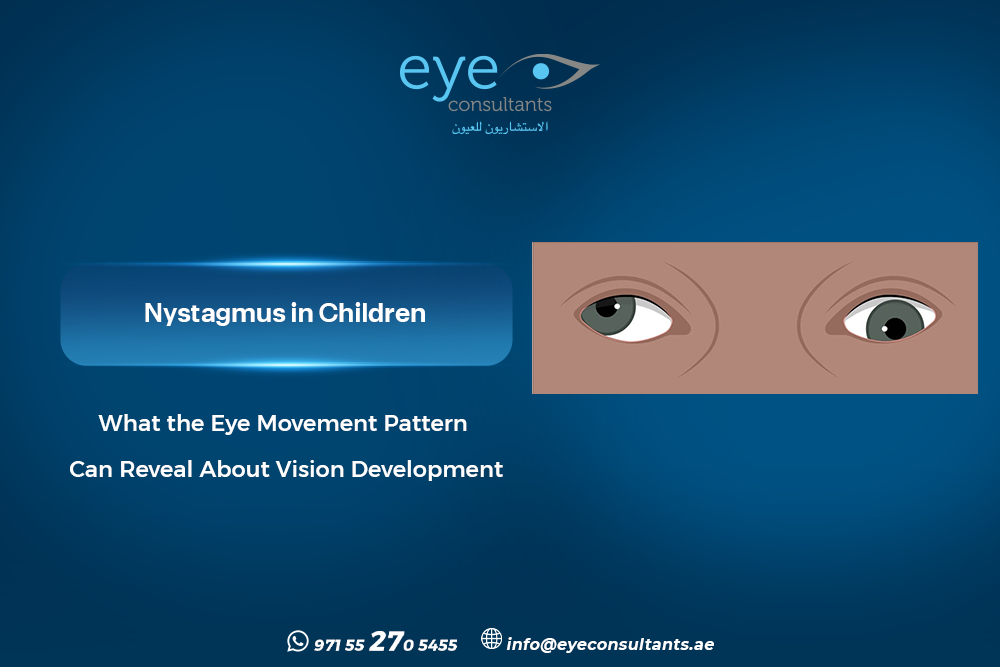
Nystagmus in children treatment starts with understanding when the eye movements began and how they behave. Nystagmus consists of repetitive, involuntary movements that may occur from side to side, up and down, or in other patterns.
Parents may notice an involuntary eye movements child when the eyes repeatedly move without the child’s control. The ophthalmologist may assess:
- Age when the movements first appeared.
- Direction and pattern of movement.
- Visual acuity in each eye.
- Refraction and eye alignment.
- Retina and optic-nerve appearance.
When movements begin during infancy, an infantile nystagmus evaluation can help determine whether they are associated with normal visual development or another eye condition.
Why Might a Child Turn or Tilt Their Head?
Nystagmus in children treatment also considers whether the child uses a particular head position to improve vision. Some children have a preferred direction of gaze, known as a null point, where the eye movements may become smaller and vision clearer.
Parents may notice a head turn with nystagmus while the child is reading, watching television, or focusing on distant objects. This position should be assessed rather than automatically corrected, as it may help the child see more clearly. (Watch also)
What Does a Pediatric Eye Examination Check?
Nystagmus in children treatment should be based on a complete pediatric eye examination rather than the eye movement alone. The assessment may look for refractive errors, amblyopia, strabismus, cataract, retinal abnormalities, optic-nerve problems, or other causes of reduced vision.
Depending on the child’s age and findings, the examination may include:
- Visual acuity and refraction.
- Eye alignment and movement assessment.
- Retina and optic-nerve examination.
- Assessment for amblyopia.
- Additional investigations when clinically indicated.
How Is Nystagmus Treated in Children?
Nystagmus in children treatment varies according to the underlying cause and the child’s individual visual needs. There is no single treatment suitable for every child.
Depending on the findings, management may include:
- Prescription glasses or contact lenses when appropriate.
- Treatment of associated amblyopia or other eye conditions.
- Pediatric low vision support when visual function remains limited.
- Medication in selected cases under specialist supervision.
- Eye-muscle surgery in selected children with a significant abnormal head position or other specific indications.
Nystagmus surgery may improve an abnormal head position or visual function in selected cases, but it does not necessarily eliminate the eye movements.
How Can Nystagmus Affect School and Visual Development?
Nystagmus in children treatment should also consider the child’s everyday visual needs. Some children have relatively good vision, while others may experience reduced visual clarity that affects reading, recognizing objects at a distance, or following classroom activities.
An assessment can help determine whether the child needs:
- Appropriate optical correction.
- Support for reading or distance viewing.
- Classroom accommodations.
- Ongoing monitoring of visual development.
The aim is to understand the child’s functional vision and support visual development rather than focusing only on the visible eye movements.
Why Choose Eye Consultants Center?
Nystagmus in children treatment requires an individualized pediatric assessment and appropriate specialist experience. Eye Consultants Center provides pediatric ophthalmology and strabismus care in Dubai, including assessment of pediatric eye conditions, amblyopia, refractive problems, congenital conditions, and strabismus.
The Pediatric Ophthalmology and Strabismus Unit is headed by Dr. Mahmoud Youssef Khattab, Specialist Ophthalmologist, with more than 15 years of experience in pediatric ophthalmology and strabismus.
If your child has unusual eye movements, reduced vision, or a persistent head position, specialist assessment can help identify the possible cause and determine the appropriate next step. (Watch this video)
Book a pediatric ophthalmology consultation at Eye Consultants Center in Dubai.
Contact us:
or visit Al Razi Building 64, Block C, 1st Floor, Unit 1017 – Dubai Healthcare City – Dubai – United Arab Emirates.
Working Hours:
Monday to Thursday and Saturday: 8 AM to 8 PM
Friday: Closed
Sunday: 9 AM to 8 PM
Frequently Asked Questions
When should parents see a pediatric ophthalmologist?
Nystagmus in children treatment should be considered when unusual eye movements are persistent, begin later in childhood, occur with reduced vision, or are associated with an abnormal head position or other visual concerns.
Is nystagmus in children always a sign of poor vision?
No. Some children with early-onset nystagmus have relatively good vision, while others have an underlying eye condition affecting visual development. A pediatric ophthalmic examination is needed to understand the cause and assess visual function.
Can nystagmus improve as a child grows?
The course varies according to the type and underlying cause. Some children may experience changes in eye-movement intensity or visual function as they grow, while others continue to have nystagmus.
Does every child with nystagmus need surgery?
No. Surgery is considered only in selected cases when specific clinical findings make it appropriate. It may improve head positioning or visual function but does not necessarily stop the eye movements.
Conclusion
Nystagmus in children treatment should always be individualized. Identifying the cause early and assessing visual development can help determine whether the child needs optical correction, visual support, monitoring, or other specialist care.